

A History of Personal Documentary
in 10(ish) Films

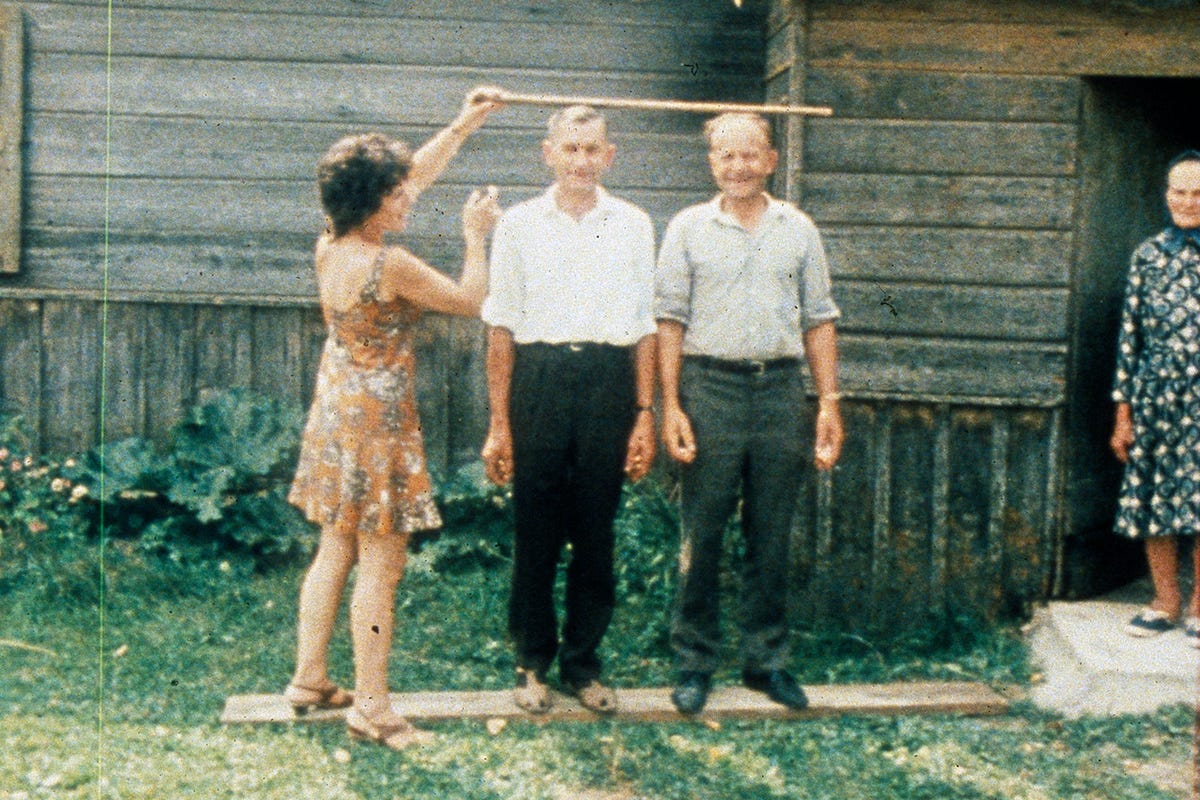
Today, Cinema Year Zero closes VOLUME 21: Creative Nonfiction Film Weekend 2025 with a list of ten further films from throughout the short but vibrant history of the genre.
In the 1960s and 1970s, technological advances allowed for more lightweight cameras and audio equipment, making way for pioneers like Jonas Mekas, The Kuchar Brothers, and Agnès Varda to create limber, intimate works that combined diaristic autobiography with social or political concerns. This is a form that puts marginalised voices and perspectives under the microscope, while challenging the boundaries between objectivity, memory, and the camera itself.
Recommendations by Sam Moore, Owen Vince, Kat Haylett, Alonso Aguilar, Ben Flanagan, Kirsty Asher, Joseph Owen, Anna Devereux, Blaise Radley, Orla Smith
Thanks again to all everyone who contributed to the issue, and to CNFW for inviting us to collaborate. You can read the entire issue here.
Reminiscences of a Journey to Lithuania (Jonas Mekas, 1972)
There’s a hazy uncertainty to the images Jonas Mekas presents throughout Reminiscences; grounded in his rambling, exploratory narration, the director’s voice seems to exist as a way to try and ground the uncertainty of memory; the schism of loss and war. Mekas describes the immigrant communities he sees in Brooklyn as ‘sad, dying animals in a place they didn’t belong to. A place they didn’t recognise.’
And yet, Lithuania is just as unrecognisable as the America that Mekas struggles to call home. The country is presented in 100 glances; fragments of footage that are less grounded and realistic than the images of America. Mekas’ eye is uncertain, looking at the impossibility of home in the tentative way one looks at the sun. Sam Moore, writer, editor, and co-curator of TISSUE, a trans literary initiative.
Extreme Private Eros: Love Song 1974 (Kazuo Hara, 1974)
Breakups make for juicy dramas and even gutsier documentaries. When Kazuo Hara’s wife—the radical feminist Miyuki Takeda—announced that she was leaving him, the famously in-your-face director threw heartbreak to the wind and set about documenting their often emotionally convulsive split. Extreme Private Eros: Love Song 1974 is the result; an uncompromising tale of intimacy and desire in which Hara pursues Miyuki’s journey toward sexual and social liberation with his characteristically voyeuristic lens—and a lot of self excoriation. In Hara’s own words: ‘I felt I had to do something; so I decided to make a film.’ Owen Vince, a writer and filmmaker.
Not a Pretty Picture (Martha Coolidge, 1976)
Autobiographical to an extreme degree, this reflexive approach to docufiction is a cathartic reenactment of Coolidge’s own rape by an acquaintance when she was sixteen years old. Shifting between repeated rehearsals of the rape scene, interviews with the actors, and a more straightforward narrative, the film constructs multiple layers of spectatorship. I find it to be not only deeply arresting but profoundly confronting; as the audience, you are compelled to bear witness, just as Coolidge watches her own rape restaged again and again—a painful but deliberate excavation of her trauma. With each take, the performance becomes more and more violent, delving closer to the truth as it simultaneously transforms it. Kat Haylett, co-founder of Ecstatic Truths.
Cabra Marcado Para Morrer, or Twenty Years Later (Eduardo Coutinho, 1984)
Cabra Marcado Para Morrer is built around an absence: a gut-wrenching ellipsis where a cut to black obscures the lived experiences of a generation that came and went. There’s no audiovisual trace of those twenty years, lost to scorched-earth state violence, and yet their spectre still looms within the registers around them, past and future. If official history presents itself in a linear fashion, it is out of the convenience of patching things up to its benefit. Eduardo Coutinho provides an alternative, affective history where unspoken truths and unsung heroes come to life via the scattered memories of a community actively looking for itself through images; recognizing how the echoes of resistance can never fade away if there’s still someone to listen. Alonso Aguilar, freelance writer, programmer and audiovisual producer.
Sherman’s March (Ross McElwee, 1985)
Ross McElwee’s diary films delve deep into the psyche of the ‘southern man’. His masterpiece, Sherman’s March, nods to literary tradition with a bifurcated structure: his attempts to make a historical account of Civil War General Sherman’s ‘March to the Sea’, a brutal episode in the history of The South, are disrupted by McElwee’s efforts to find a wife. Cringeworthy confessionals ensue, but what lingers are the heartbreaking depictions of the women he leaves in his wake. This exploration of southern womanhood is part-Philip Roth, part-Confederacy of Dunces (1980), a chronicle of male romantic foibles, of ego and id in an era of perverse nuclear anxiety. Ben Flanagan, Cinema Year Zero editor-in-chief.
Gallivant (Andrew Kötting, 1996)
Andrew Kötting’s debut feature is a landmark full of landmarks. In the vein of photographer Iain McKell’s Beautiful Britain (2012), he weaves the idiosyncrasies of Britain’s seaside semiotics, folklore, and Christian iconography into a deeply personal journey around the coasts of Britain with his daughter Eden, who has a rare condition called Joubert Syndrome, and his grandmother Gladys. Kötting’s work, but perhaps most especially Gallivant, has set the tone for the twenty-first-century folk revival and for collectives such as Weird Walk to embrace a re-enchantment of Britain’s landscape, and a modernised appreciation for its history and heritage. Kirsty Asher, Cinema Year Zero associate editor.
Bye Bye Africa (Mahamat-Saleh Haroun, 1999)
Chad’s Mahamat-Saleh Haroun would score an arthouse hit with 2021’s Lingui: The Sacred Bonds, but for our money his first feature, Bye-Bye Africa, deserves more attention. Haroun plays Haroun, who returns to Chad from Paris after a personal loss and sets out to make a film. But soon, he realises that his homeland’s cinema culture is falling apart, with cinema palaces replaced by sterile video rooms. Twisting travelogue into anti-imperialist manifesto, Haroun asks questions of who may access culture and history, with a limber camera that captures Godard’s spirit while trawling the reality of African filmmaking. BF
Stories We Tell (Sarah Polley, 2012)
Few terms in recent memory are as spoiled as ‘storytelling’. In cloddish hands, it becomes shorthand for reason, cause, chronology. Yet the best narratives not only articulate but retilt experience: they are shapeshifters, mechanisms for dissonance, discrepancy, contradiction. Stories can do it all. That’s the trouble. Sarah Polley understands the deceptive essence of story, and in Stories We Tell, she insists upon its plural. In reporting the tragic mysteries of her birth and upbringing, Polley attributes ‘equal weight’ to a family of witnesses. By doing so, she restates the challenge of truthful expression: how noble, eloquent, and impossible it is. Joseph Owen, research fellow at University of Southampton.
The Image You Missed (Dónal Foreman, 2018)
Belfast and Dublin are of no great distance from each other, but in 1985, when director Donal Foreman was born, violence and legacy brought a chasm between them. In this film, Foreman addresses his estranged father Arthur MacCaig, director of acclaimed Troubles documentary The Patriot Game (1978), displaying MacCaig’s stirring footage of the North side-by-side with his own part-joyful, part-searching home movies. Growing up in Dublin, the violence over the border barely touched MacCaig, although his father was embedded in Republican communities there. The film communicates the weight of such distances: Republic turning away from the North, father turning his back on son. Multiple times we are shown the Dublin-Belfast train crossing the Royal Canal. The journey looks deceivingly easy. Anna Devereux, PhD researcher at University of East Anglia.
Krabi, 2562 (Ben Rivers, Anocha Suwichakornpong, 2019)
That which dies is born again—a fact of life in the Krabi, a popular tourist spot and filming location in Southern Thailand. As a tourist destination, Krabi is forever looking backwards, a living, breathing town that survives, in part, by trading on its storied past. As a movie location, aestheticised beaches and national parks keep that same cycle in motion; a golden vision of a place that doesn’t exist designed to draw in a new crowd of paying mouthbreathers. To what extent directors Suwichakornpong and Rivers become part of that process with their strange, atemporal docufiction hybrid, Krabi, 2562, is a question they continuously probe. Part-inverted travelogue, part-observational documentary, part-personal diatribe, in a place where history only exists in the abstract, where is there to go next? Blaise Radley, Cinema Year Zero reviews editor.
The Rehearsal (Nathan Fielder, 2022 & 2025)
‘Creative nonfiction’ isn’t just high-minded and artsy; it’s also Borat, Jackass, and the works of such luminaries as Nathan Fielder—comedians playing characters (or characters of themselves) plunged into the real world to test its moral mettle. The Rehearsal is the high watermark: a twisty, unpredictable TV show where a deadpan Fielder puts real people through elaborate simulations to ‘rehearse’ conflicts they are afraid to confront in their actual lives. The final episode of Season 1 is as knotty and confronting an account of the moral conundrum of hiring child actors as you’ll find—more nuanced for the fact that its context is a comedy show that doesn’t offer neat conclusions. And the heights Fielder goes to in Season 2 for the sake of authenticity has to be seen to be believed. Orla Smith, The Creative Nonfiction Film Weekend festival co-director.