

Announcing Cinema Year Zero at Cinema Rediscovered 2026

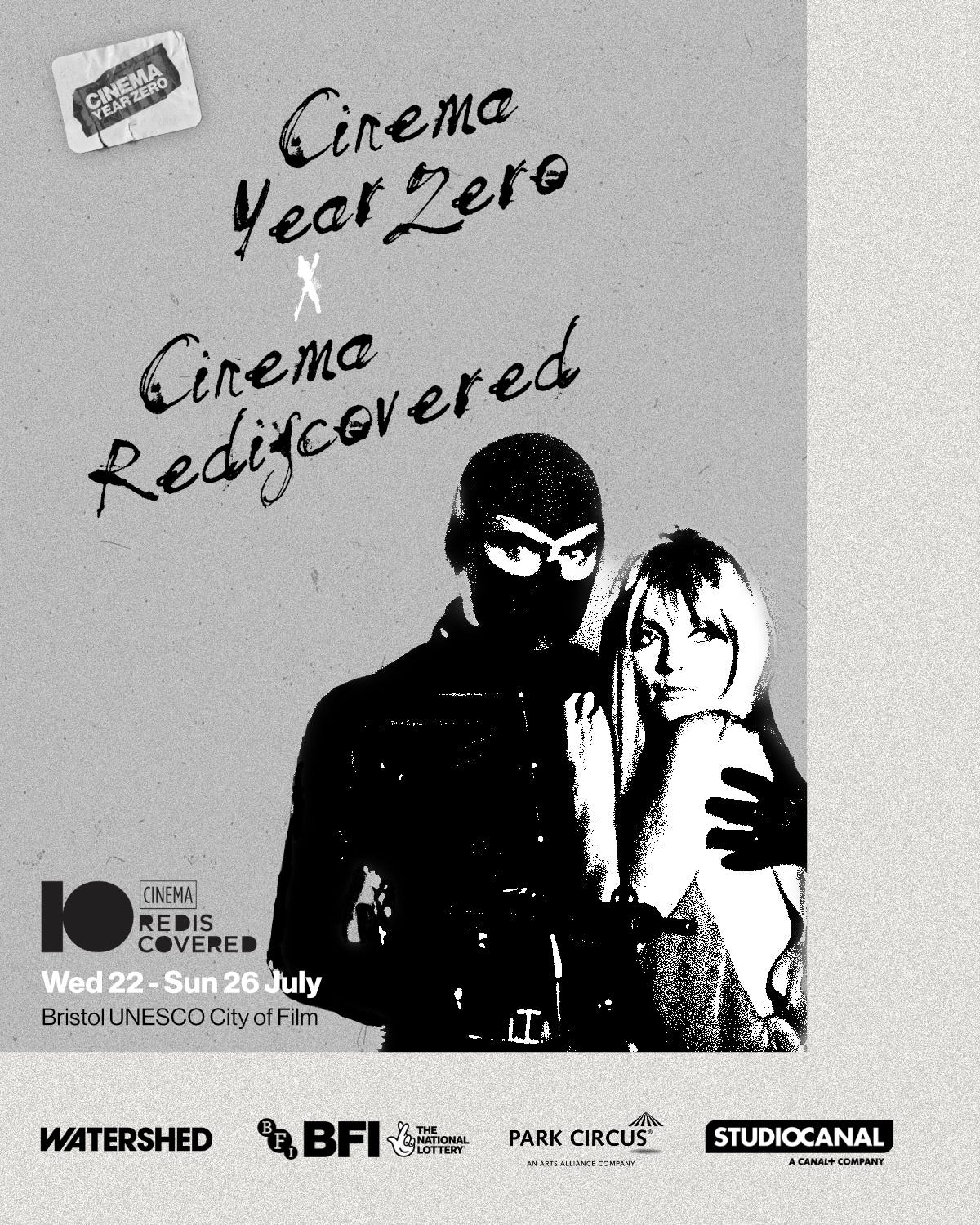
Today, Cinema Year Zero is excited to announce that we are partnering with Cinema Rediscovered Festival 2026.
The festival, which takes place in Bristol from Wednesday 22nd to Sunday 26th July, focuses on reviving restored and forgotten films from the history of cinema. It is Britain’s leading hub for repertory cinema, with the industry-focused Reframing Film Sessions always impacting the following year of exhibition.
But the festival has endured over the last decade through its dedicated audience focus. This year, strands include Comics Come Alive, Rogue Hollywood, Restored and Rediscovered, 50 Years of Aardman at Cinema Rediscovered, Reframing Film, and Vive Le Cinema!
For our part, Cinema Year Zero will publish an essay for each day of the festival on a film in the programme. These will be available online here, and in print at Watershed.
Following Les Sièges de l’Alcazar screening on Friday 24th July, we will be hosting an informal discussion of the film’s depiction of the pratfalls of cinephilia at Watershed café/bar https://www.watershed.co.uk/whatson/14062/les-siges-de-lalcazar
We will also host a Critics Salon, featuring readings from the commissioned essayists along with conversation about our critical practices. Free to attend, with more details to follow.
Cinema Rediscovered’s Festival Producer Madeleine Probst had this to say: “We’re delighted to partner up with independent publication Cinema Year Zero on this 10th anniversary edition to platform new writing by film critics and create a space at the festival for peer sharing work. It’s especially fitting as members of the editorial team Ben Flanagan and Kirsty Asher were participants in Tara Judah’s Film Critics workshop during early editions of the festival. We share a passion for cinema, for developing film criticism and are both committed to creating paid opportunities for writers where possible.”
Below, we have picked 10 highlights from the festival. But there’s so much more. You can find the full programme and tickets here: https://www.watershed.co.uk/cinema-rediscovered-2026
10 to see at Cinema Rediscovered 2026
Danger: Diabolik (Mario Bava, 1968, Italy)
Produced during the peak of Bondmania, Danger: Diabolik reenvisions Britain’s most recognisable export as an Italian master thief, cladding him in a black skin-tight suit and amplifying his sexual lasciviousness (if you can imagine such a thing) into something more… well, dangerous. There’s a strange sensuous quality to Diabolik (John Phillip Law), unsettlingly lithe in his acts of violence as well as his love-making, that makes him a slippery prospect as a main character. No-one can even seem to agree how to pronounce his name in his own film. Enter at your own peril. Blaise Radley
(El Chacal de Nahueltoro) Jackal of Nahueltoro (Miguel Littin, 1969, Chile)
This fiery fable, based on a murder case which shook 1960s Chile, is probably the South American nation’s most famous film. Director Miguel Littin, who was later exiled during the Pinochet regime, proceeds through the case with a documentarian’s eye, questioning the value of atonement and sympathy in a bureaucratic state. Lyrical voice over applies questions and answers from media interviews with the killer (Nelson Villagra) to brutal scenes. Limber handheld camerawork, and fragmentary edits that evoke the era’s modernist masterpieces, lift the dramatic landscapes to an even higher plain. Newly digitised in 4k by Cineteca Nacional de Chile. Ben Flanagan
Trees Lounge (Steve Buscemi, 1996, USA)
The flowering of the American independent film movement in the late 1980s and 1990s led to plenty of sub-Tarantino slop, but it also allowed for Trees Lounge, a languid, semi-autobiographical slice-of-life shaggy dog story that deliberately never quite goes anywhere. The film’s director and star Steve Buscemi commits to depicting the boredom and repetition of functioning alcoholism, but not as a grim miserabilist; drawn from his own experiences, he understood how tedium can animate and slowly infect the barfly’s life until there’s nothing left but an empty glass. It’s coloured with sharply observed humour and a top-tier cast: Buscemi’s stop-start directorial career never eclipsed his acting work, but his debut is an undersung pleasure. Fedor Tot
50 Years of Aardman at Cinema Rediscovered
Radioactive dust falls from green skies; malicious, black-tied men make totalitarian speeches about arms trade and profit; a sparse soundtrack of howls, groans, burps, gulps and rumbles: here in Aardman’s 1986 short Babylon we find the origins of the beloved, Bristol-based animation studio’s beloved fuzzy contemporary style. Celebrating Aardman’s 50th birthday, Cinema Rediscovered presents a trio of events with co-founders Peter Lord and David Sproxton: shorts programme Sweet Disaster (including the sinister Babylon described above), a deep dive into the playful world of Morph (one of the studio’s first characters), and documentary Peter Gabriel: Sledgehammer Revealed explores Aardman’s innovative stop-motion work for Gabriel’s 1986 music video. Anna Devereux
The Movie Orgy (Joe Dante, 1968, USA)
Joe Dante is known for his affectionate satire of mid-century Americana in Gremlins (1984), Matinee (1993), and Small Soldiers (1998), something you can trace back to his days as Head of his student Film Programme. The Movie Orgy began as an experimental screening, with several vintage film reels set up on different projectors—when one got boring he would switch to the next, and splice in cartoons and adverts. With the projectionist as auteur, responding to audience reactions, each subsequent showing saw the project evolve further and faster ending up with the film in its current form at over 2000 cuts and a treasure trove of clips juxtaposed together in this hilarious pop-culture mélange. Ellisha Izumi
Le Boucher (Claude Chabrol, 1970, Italy, France)
Le Boucher begins with a regimented village-wide operation putting together a wedding, shot in the same reticulated way one would draw a multiplication table. It climaxes with a haunting set of close-ups, humid with desperation. In between, Claude Chabrol sticks the viewer like Blu-Tack to the Les Eyzies township without a whiff of touristic glazing; sketches Hitchcockian flashpoints on a subtler scale than the master; gives a classic middle-class wedding meet-cute a blooming maturity amongst the southwestern woodlands; and heaves a funeral at his audience like a ship coming into port, complete with an open grave surging towards the camera in a beautiful wide-angle composition. Tom De Lancy Green
Goodbye, Dragon Inn (Tsai Ming-liang, 2003, Taiwan)
In a Taiwanese movie theatre soon to be closed forever, a smattering of clientele gather to haunt it one last time. Bored tourists and cruisers, disinterested theatre staff, and two aging actors reminiscing on their former glory all constitute the theatre’s final audience. Screening as part of Cinema Rediscovered’s Vive le Cinema! in celebration of the festival’s 10th edition, Tsai Ming-Liang’s slow cinema classic Goodbye, Dragon Inn fills its long, ponderous takes with quiet contemplation about death and cinema. Finality and continuity find a coexistence in this gloriously serene, morbidly funny swansong of the cinemagoing experience. Kirsty Asher
Mikey and Nicky (Elaine May, 1976, USA)
Elaine May decided to out-Cassavetes Cassavetes with Mikey and Nicky, and presumably rubbed it further in his face by casting John Cassavetes himself in it. The result is a truly ugly nighttime odyssey, which starts out poorly for Cassavetes’ Nicky and only gets worse from there, the arrival of old pal Mikey (Peter Falk) nothing like the balm of friendship it’s supposed to be. The film has a brilliantly raggedy quality: it seems somehow entirely improvised at times, the grungy, scruffy atmosphere looking as if it’s just walked in on its protagonist’s self-destruction. Yet given that May is a famously perfectionist director, we can only assume that this off-the-cuff spirit is the work of meticulous preparation. Fedor Tot
Chronically Online: Archiving and Activating Online Moving Image for Audiences
In 2024, the BFI National Archive embarked on ‘Our Screen Heritage’, an accelerated acquisition programme to preserve hundreds of online moving image works. They have partnered with The Creative Nonfiction Film Weekend (CNFW) on ‘Chronically Online: A Personal History of the UK Internet’, to engage audiences with this material. Join CNFW for a screening of early internet video and a discussion about what it means to preserve online moving image and to screen it in cinemas. They’ll be joined by Will Swinburne, Curator at the BFI National Archive, and special guest Paul Weedon (the viral video star who once said “I can’t believe you’ve done this”). Orla Smith
Nostalgia (Andrei Tarkovsky, 1983, Russia/Italy)
“I am fed up of all your beauties.” Having just concluded my own mini-trip to Italy, I understand the overwhelming strain of another fresco. I had never heard the phrase trompe-l’œil spoken aloud until a month ago. In what amounted to a few days, I heeded its call like a death knell. I saw many churches and palazzos, an infinity of columns, altars, and doorknockers. I, too, longed for home. Tarkovsky’s Nostalgia paints the drama I’ve described in a more profound light, its protagonist Andrei a sorrowful Muscovite who can’t abide a lick of della Francesca’s plaster-work. This is a gorgeous film whose mysteries are wrapped in emotional candour. Steaming baths, a freak babydoll, the red-head’s coquettishness: all gasp-inducing. Technical gimmicks abound, trimmed to a fine point: revelatory tracking shots, insidious zooms and breathy pulls, outrageous tableaux. Tarkovsky’s visual tropes remain steadfast. A perforated farmhouse, water gushing through the cracks. Monochrome evocations of time past, held together in time present. Almost my experience, then. Instead, the film amplifies an additional world beyond mortal sense, and by the end, two solid tears rolled down either cheek. If only I shared the hubris of Eugenia, Andrei’s thwarted tour guide: “Not only am I a good translator, I improve on the original.” Joseph Owen
This article is part of Cinema Rediscovered’s Other Ways of Seeing, a development opportunity supported by BFI awarding funds from National Lottery.