

Cinema Year '25: December
I Only Rest in the Storm / Fiume o Morte! / Fackham Hall / Belfast, Maine

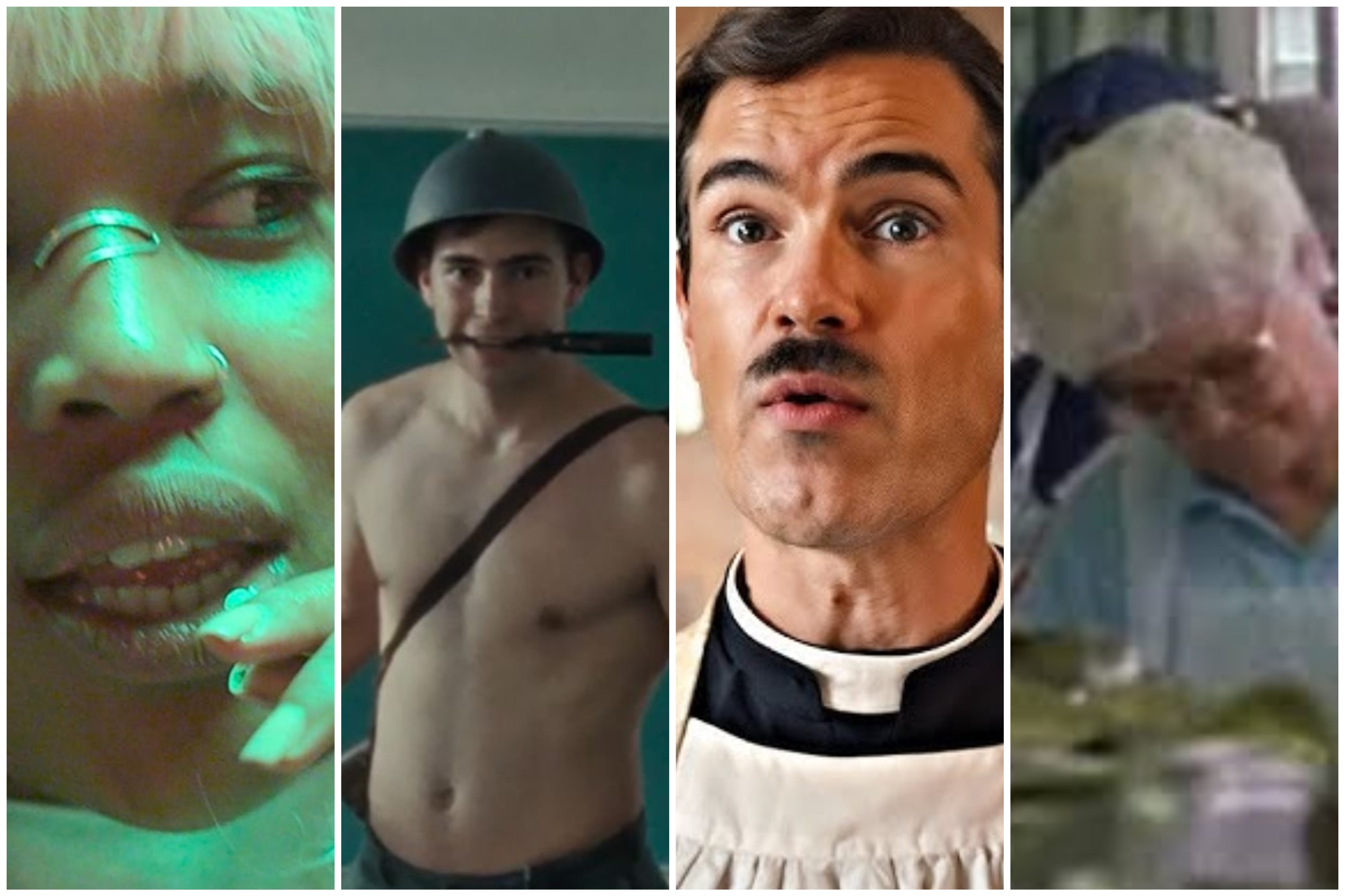
Welcome back to Cinema Year ‘25, a monthly review supplement. December rounds off the year with films designed to challenge patience, the spoils of which are various. Words by Blaise Radley, Kirsty Asher, Ben Flanagan, Tom de Lancy Green.
We will be return in early January with the results of our year-end poll.
And you can get tickets for our screening series, NOT BY LYNCH, here. It kicks off on Jan 16th with Fritz Lang’s The Secret Behind the Door (1947).
Don’t forget to subscribe to receive this and more film writing direct to your inbox.
I Only Rest in the Storm (Pedro Pinho, 2025, Portugal)
I’ve often found myself on the combative side of our new release capsules this year (though, in my defence, the blame for that lies with Del Toro et al), so I’m glad to end the year with something nice to say. And I Only Rest in the Storm, the latest work from Pedro Pinho, is certainly an easy film to pile superlatives on: for its extreme length at 211 minutes, for the many moral complications it throws at the viewer in its biting depiction of NGOs, and for its blurring of the lines between documentary and fiction. All that and some of the more disarmingly hot queer romance I’ve seen in 2025.
I Only Rest in the Storm follows Portuguese bisexual waif and environmental engineer Sérgio (Sérgio Coragem—all named actors share their names with their characters) as he travels to Guinea-Bissau to carry out an environmental impact report on the potential construction of a new major highway. Except, in the same fashion as the bureaucrats in Albert Serra’s similarly-barbed postcolonial critique, Pacifiction (2022), Sérgio spends most of his time getting loaded, cosying up to the locals, and trying to fuck anyone who looks his way—smiling all the while with polite good intentions. When confronted with the problematic aspects of his job and whiteness, he ‘sits his ass down and listens’, so to speak—but does any of it actually take root?
At times, Pinho’s filmmaking style is dryly anonymous, told mostly in floating handheld medium close-ups of the character’s faces and wides that place them small as ants in the hotly-contested landscape. But there’s also a pointed understanding of rhythm and the way editing can dilate time that gradually instills a dreamlike effect. Certain tasks are debated at length, only for the action to be skipped over; other times, we spend extended periods focused on a specific process, before realising the destination has suddenly been reached off screen. As Sérgio embeds himself further and further in West Africa, despite his every interaction being mediated (whether through an interpreter or different lenses of lived experience), you sense an end—or climax—won’t be forthcoming. Pinho, to his credit, keeps you guessing to the end. BR
Fiume o Morte! (Igor Bezinović, 2025, Croatia)
Mirroring my colleague Blaise, I am this month transformed from grumpy humbug to merry cinemagoer by way of the ICA. The root of this festive joy is Igor Bezinović’s documentary/historical re-enactment/local heritage project Fiume o Morte! which retraces every documented event from the takeover of the Croatian city Rijeka by the Italian poet, proto-fascist, and regular gak-huffer Gabriele D’Annunzio.
Bezinović’s home city has found itself within the borders of numerous states, empires and regencies, but D’Annunzio’s ascendence to its unofficial head remains a unique and notably bloody occurrence in its history. For a region that has been so embattled in its statehood, and for its people who have endured shifting national identity, it feels highly pertinent of Bezinović to create this project with the collaboration of Rijeka’s citizens, many of whom have never performed before, let alone been on camera. He selected a range of suitably bald men to play D’Annunzio through various stages of the historic event, and asked his collaborators to learn the Fiuman dialect (an Italianate dialect of the Venetian language) for the film’s narration.
I am always partial to performing the archive, and Bezinović cuts as close to the historic cloth as possible, recreating the numerous photographs and footage reels available with his merry band of locals. In doing so, these people with ancestral connections to the city deliver a fascinating and often whimsically funny piece of performance art, rediscovering a historic event through their involvement in its re-enactment. The expanse of time and progress between D’Annunzio’s illegal occupation and the present day is captured deftly by Bezinović—a man rides an electric scooter across the plaza where bloody fighting took place; a local binman, playing D’Annunzio during the takeover, delivers his triumphant speech from the balcony of the local authority building to an empty street, with only his wife and son applauding; reenactors of the fascists trashing Slavic businesses throw a chair out of what is now a smart phone repair shop.
Most chilling, though, is how easily and enthusiastically the reenactors take to their roles as the fascist footmen, marching and singing along lustily to the fascist hymn ‘Giovinezza’, having been adamant pre-performance that they would never want to be a real-life soldier. Placing one’s self in history’s shoes has its merits, but, as with the daydreamings of the online fascist movement, Fiume o Morte! serves to remind us how much of propagating ideology boils down to playing dress-up and putting on a show. KA
Fackham Hall (Jim O’Hanlon, 2025, United Kingdom, USA)
Though I come not to praise Fackham Hall but to bury it, Jim O’Hanlon’s Downton Abbey spoof should be memorialised as one of the year’s most representative artefacts. For this may be the first occasion that ‘forwarded many times’-type humour has been literalised on screen with such shameless abandon. Wide shots of ballrooms or tea parties are filled with lashings of dead space. The stillness of the actors might resemble a take on Kabuki, if it didn’t serve to highlight the cheap imitation of class in the set dressing and costumes. All the better to crop you with. Written by a crack team of Footlights or thereabouts (notably including Jimmy Carr) Fackham Hall is slop crafted with the explicit intent of being sliced into clips for Facebook.
And still I laughed, alone in an empty Peckhamplex having bought a ticket from a suspicious usher. This must be what it felt like going to see Deep Throat in 1972, but without the comfort of the crowd. If Fackham Hall catches you in the right moment, you will laugh too: at the non-specific cockney pub set piece, at the extended murder reveal sequence, at the baffling references to such cultural touchstones as the Amazon Alexa and Jonah Hill. The real giveaway that it’s all directed to a Yank audience comes when Thomasin McKenzie says ‘Thank you for your service,’ to a British soldier—Winter Wonderland is thataway.
Carr, that paragon of ethics, has around a million views on a clip from the ‘Triggernometary’ podcast (hosted by comedians-cum-thought leaders Konstantin Kisin and Francis Foster) in which he gives the sensible middle-ground opinion that the government should mine bitcoin. How many of those viewers went to see Fackham Hall? With its not-so-casual sop to American sensibilities, a large budget comedy vehicle should be the pinnacle of a guy like Carr’s career. Instead, the film is a promotional vehicle for him to appear on podcasts and further his brand as a political figure. Clearly, the big bucks are actually in reactionary podcasts and corporate events designed to cover up human rights abuses, like the Riyadh comedy festival and the British Museum’s ‘Israeli Independence Day’ celebration. In his hunt for accession, Carr has laid bare the endpoint for the contemporary fame rubric. BF
Belfast, Maine (1999, USA, Frederick Wiseman)
Orange gels enclose the sky in a rich tangerine slab above the deep blue water at the opening of Belfast, Maine (1999), overture to bloc 2 of Frederick Wiseman at the BFI. All these restorations shimmer and pop in 4K, and yet this opening image of an awakening horizon has more in common with the crushed, bleary dawn of Monet’s Impression, Sunrise than the sharp angularity of those black-and-white early features we saw last month.
One rarely thinks of Wiseman as a visual artist, at least in the pictorial sense. More often, his aptitude is taken to be structural, rhythmic, sociological. But once one notices the Monet/y shot, other painters, sculptors, sketch artists fall into his orbit.
Trace Hugo Gellert’s monochrome machinic lithographs in a cannery’s nervous system of conveyor belts and ashen sardine vats,. Edward Hopper returns repeatedly to flat, unobtrusive American street corners - Wiseman hurtles around sunny or lamplit Queens for the many In Jackson Heights (2015) establishing shots. Seurat’s Bathers at Asnières: peachy skin and tired blues bounce off the polis in the park at the height of an AIDS summer in Central Park (1990). Even the sheer proliferation of wood-browns and camo-greens in At Berkeley (2013) is enough to bring to mind Caravaggio’s lamplit sequestrations, Cézanne’s landscapes, countless others.
With the exception of At Berkeley, this second bloc favours habitation over examination. Precision is at play at the most minute level, almost unseen amidst the wandering, incidental shoulder-jostling with place and time. Central Park most especially fulfils Owen Hatherley’s long-running criticism of overdetermined architecture: that it neuters the accidental and spontaneous. Wiseman fixates on roads tangling up with plant-life like overlapping tree branches, and this weird oasis in mid-Manhattan, strangely, becomes the very place where the beautiful friction of the urbane is realised. Anarchic biology, clashing ecosystems, a blank canvas of encounters and chance. Every film of his is like this – a summary, of sorts. TDLG