

Cinema Year '25: November
House of Dynamite / Frankenstein / The Running Man / Wicked: For Good

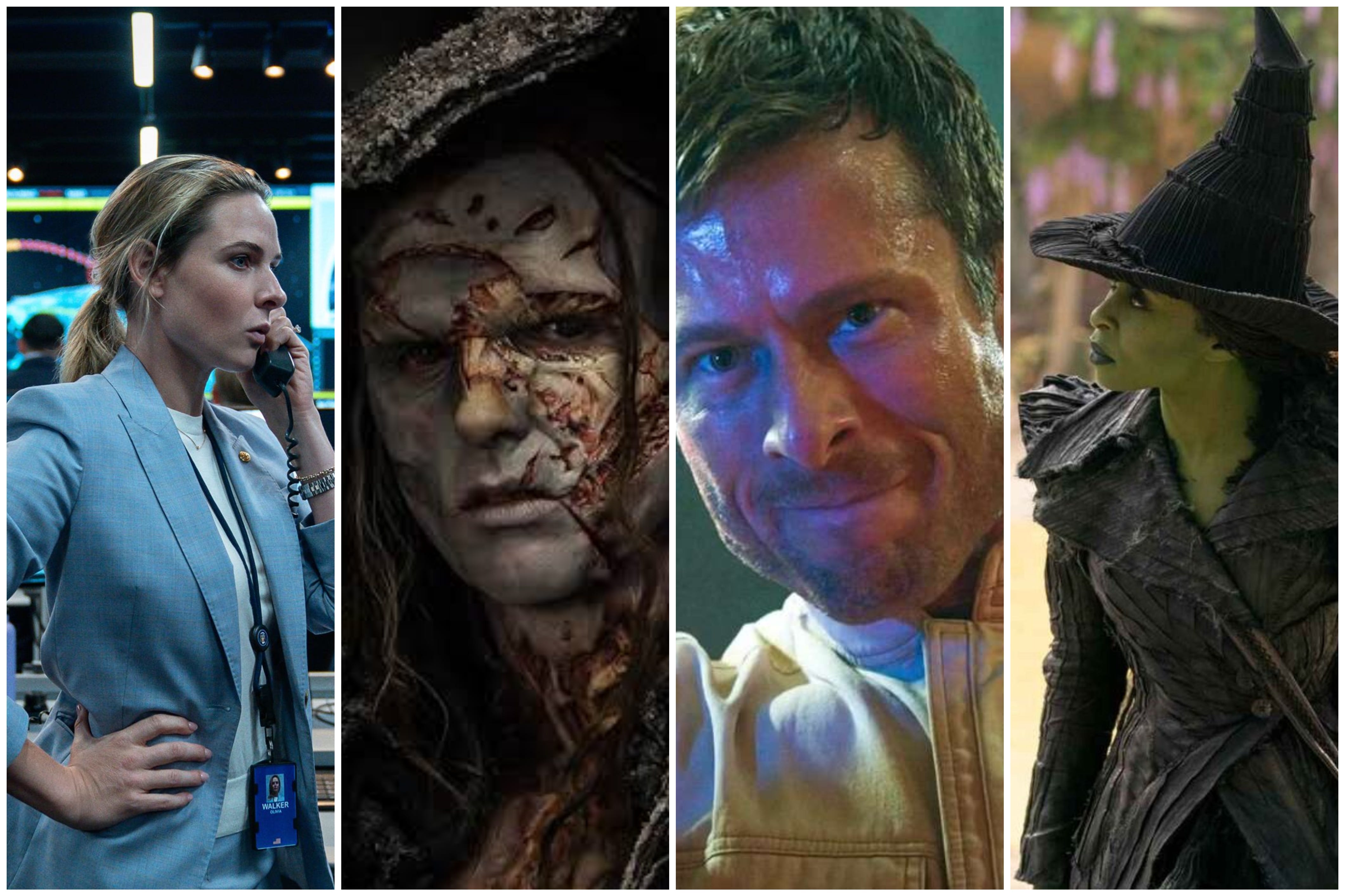
Welcome back to Cinema Year ‘25, a monthly review supplement. November’s new releases drove us to question the sanctity of the cinematic apparatus. Words by Tom de Lancy Green, Blaise Radley, Ben Flanagan, Kirsty Asher.
Don’t forget to subscribe to receive this and more film writing direct to your inbox.
Did you attend an interesting repertory film event this month and want to write about it? Get in touch yearzerocinema@gmail.com.
House of Dynamite (Kathryn Bigelow, 2025, USA)
House of Dynamite is turgid, zealous, cliched, visually blanched, and probably one of the better portrayals of American militarism’s perverted self-immolating destiny. Like Zero Dark Thirty (2012), it deserves a reputation as equally jingoistic and modernistically autocritical, Starship Troopers (1997) without the joke. Verhoeven throttled his barely-veiled cultish machismo in Scandi action figures like Casper Van Dien and a mélange of soap-opera lighting; Bigelow updates his stare into the abyss for the 21st century, perfecting and pulling apart Paul Greengrass’ glassy long lens frenzy.
The style flattens the mise-en-scene like layers in a 2D collage skimming against each other. Appropriately, the film concerns the state’s fractured response to a nuclear launch that will flatten the Great Lakes region. The situation is replete with a hard-headed general (Tracy Letts), war room lanyards (Rebecca Ferguson, Gabriel Basso), a poignantly phlegmatic army drone (Anthony Ramos) and the President, who remains a faceless but obvious Idris Elba until the film’s third act. Screenwriter Noah Oppenheim sketches these characters thinly enough that they can make for a nice addition to the machine. The enterprise (the film and the military state which it details) runs without bravado or friction, without haste or lethargy. Excitement instead stems from watching the different ways officialdom can be a synonym for submission—the missing character is the Logic that backs everyone into corners.
The film squeezes tight enough that strange details spurt out to create a third dimension to the ensemble. Strands of fatigued hair spattered around the edges of Ferguson’s kettle-shaped Swedish face; a brief sojourn to the women’s basketball league where Elba sinks a few three’s; the sallow pudge of Jared Harris’ beleaguered SecDef; a pointed and well-blocked Civil War recreation watched by the perfunctorily cast Greta Lee. Its final left-hook—a cowardly, ingenious closing move from Oppenheim—leaves one aghast at the film’s faithlessness, but convinced by it all the same. TDLG
Frankenstein (Guillermo Del Toro, 2025, USA)
For a long time I did my best to look past Guillermo Del Toro’s more eyerolling tendencies—the fedora-tipping nice guy schtick; the clockwork steampunk fetishism; the simplistic “man is the true monster” moralising—because, with the American mainstream in such dire straits, there were bigger fish to fry than blockbuster cinema’s most neckbeard auteur. But with his latest creature feature, a bloated, superficial adaptation of Mary Shelley’s Frankenstein for the mothership of bloat and superficiality, Netflix, it’s time for us to concede—maybe he kind of sucks.
In taking on a cornerstone text in Frankenstein, you sense Del Toro aiming to complete his ascension to the throne of contemporary Gothic (bar the equally eyebrow-raising Robert Eggers, who else stands in his way?). In interviews he’s emphasised over and over that this is a passion project, a labour of love, a story that spoke to him deeply. And yet it’s hard to believe this is the work of a man who called Shelley’s original text ‘“the Bible”. Faced with the enormity of creation, the rippling after-effects of man’s ambition, and the essential loneliness of existence, his writing more often evokes “things that go bump in the night” childishness, while his formal tendencies skew increasingly toward the anonymous; long floating takes that do little but emphasise the scenery behind his characters. Better to focus on the immaculate detail of the production design than Oscar Isaac’s pantomimic turn as the now-moustache twirling Dr. Frankenstein, perhaps.
Regardless of his affinity for the book, in practice Del Toro is far more interested in finding visceral thrills in gory set pieces than in the horror of man reckoning with his hubris. By bending the source text to match his gruesome fairytale aesthete, the effect is flattening on every front—a film that exists solely within the visible confines of the meticulously constructed sets (borderline masturbated over by Del Toro’s roving lens) that serves up its massively-simplified philosophical answers with helpful airplane noises. “Neeeow,” says Del Toro, as his crying monster pulls a man’s jaw off, sad at having had to carry out such a sick finishing move. “Weeee,” he says, as someone helpfully tells the constantly repulsive Dr. Frankenstein, “You… are the monster.” Muster faint praise for the set dressing and Elordi’s quietly-weighted (though still annoying) performance as the monster if you must, but anything more is just opening wide for the spoon.
BR
The Running Man (Edgar Wright, 2025, USA)
How good should an Edgar Wright film be? The West Country spoofsman-turned-hack should be no-one’s idea of a termite artist, but if he’s operating in this schlock space then I’d rather see his craft than Collet-Serra’s.
The Running Man is a plea for movie jail forgiveness. It’s in the plot, in which a Glenn Powell everyman participates in a gameshow: evade the media controlled authorities long enough to obtain personhood. The Stephen King source is ignored, vibes-wise, aside from a sequence set in Derry which leans heavily into the It-Christine school of Americana. The teacher? Baudrillard. Each new area in Powell’s run is a chance to explore a different set of aesthetic values—the metropolitan chaos of New York (populated by an abundance of ‘hookers’), the dingy dystopia of Boston (populated by an abundance of ‘hookers’), and then on and on through the more sparsely populated heartlands. But the film is steadfast, always reminding itself to be more normal.
Wright’s personality cannot help but get in the way, however. His virginal fear of hetero relationships—mined for millennial comedy in Scott Pilgrim, mined to male feminist ends in Last Night in Soho—suits the neutered Hollywood churn in which a male hero’s quest to return to family is never embellished beyond the connotation of the F-word. In that way, Glen Powell has taken all the wrong lessons from his mentor, Tom Cruise. Powell may be the great white hope, but his angry performance is one-note, comic quips landing with a smug thud.
Startling parallels with One Battle After Another (a revolutionary Gil Scott-Heron needle drop, an underground tunnel system, some awkward questions around race) do Wright’s film no favours, particularly as this was supposedly picture locked just a few weeks ago. When his overload of style is in motion, his quick editing, and clear blocking remain a thrill. But the air of self-hatred lingers around this piece of Eunuch Cinema. BF
Wicked: For Good (John M. Chu 2025, USA)
The late, great Howard Ashman asserted that the purpose of musicals is for the expression of an emotion too great to convey simply through speaking. Cynthia Erivo and Ariana Grande understand this indefatigably as performers, and whether it’s their chaotic press tours or the troubling codependent relationship they’ve cultivated, it is their bond both on—and off—screen that has kept this Oz-ian juggernaut chugging.
That emotionality is essentially where any appeal of this film ends. Even the most ardent of Wicked musical fans will tell you that the second act is notoriously unwieldy, attempting to shoehorn the events of The Wizard of Oz (1939) and the origin of the Scarecrow and Tin Woodsman into Elphaba and Glinda’s story, leaving plot holes the size of the Deadly Desert. It should have been neatly storyboarded into the end of the first film. Instead, we have unnecessary and forgettable new songs, and a Glinda backstory that does nothing but give some precocious theatre kid her SAG membership. Michelle Yeoh remains bafflingly, catastrophically miscast as Madame Morrible since she simply cannot sing, with more or less all her solo parts cut from the film. The saving grace is that her wuxia training makes for excellent sorceress armography. Jeff Goldblum also surprisingly brings more depth and emotion to his closing arc as the Wizard than in any of his recent work.
According to Instagram user buildrbear, film critics are no longer necessary for discerning the merit of the Wicked films, or indeed any film with an overt influence on contemporary popular culture. Any fan who declares this as a form of liberating “let people enjoy things” consumption of art is in fact confining themselves to grin inanely through something they may actually, in their heart of hearts, not enjoy, all for the sake of ensuring its popularity. What a cold and fruitless life to lead. KA