

Cinema Year '26: April
Worm / The Super Mario Galaxy Movie / Dracula

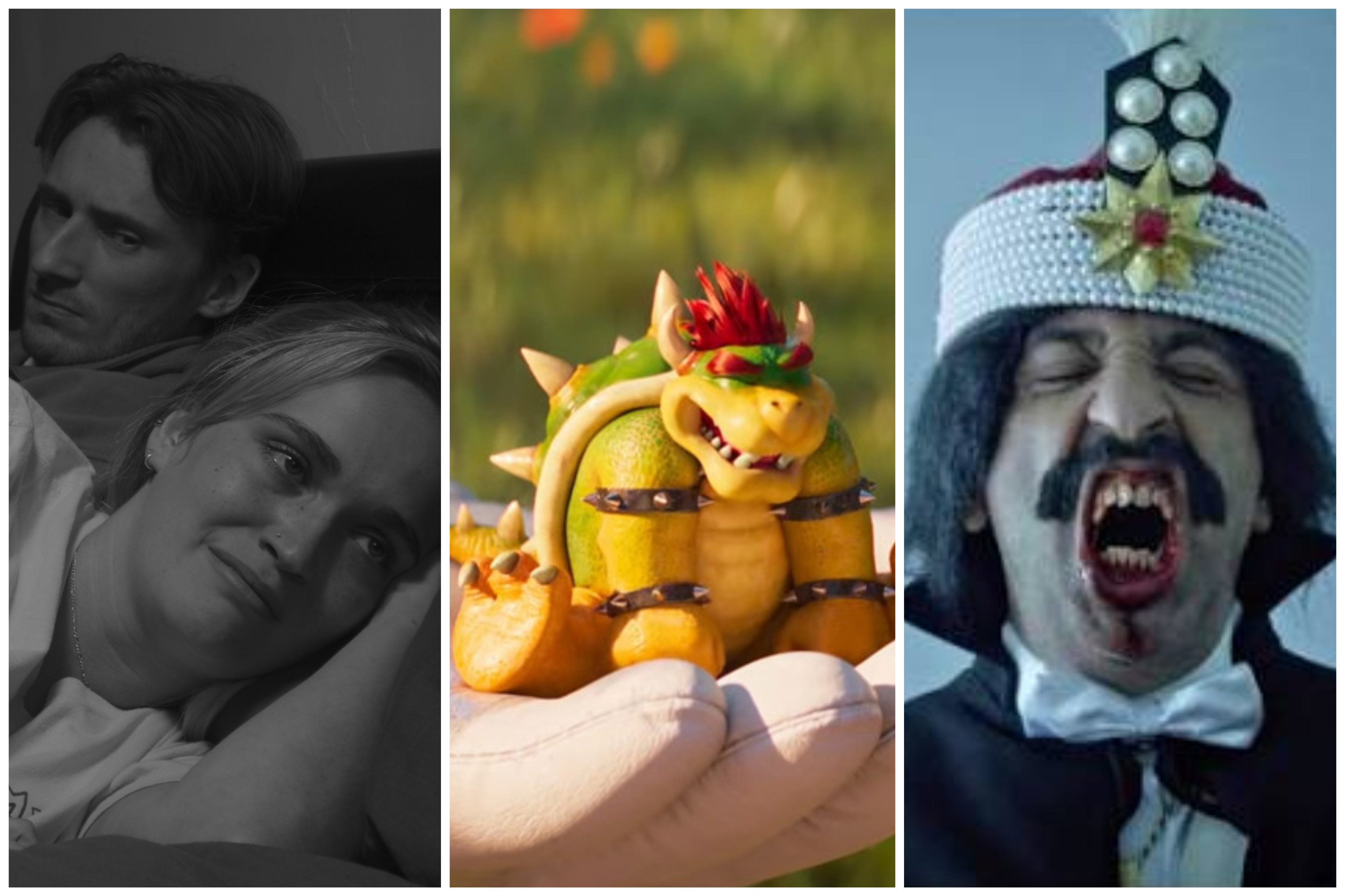
Welcome back to Cinema Year ‘26, our monthly review supplement. This month we encountered an indie horror of online anxiety, a blockbuster plagued by AI-accusations, and a romanian arthouse film that rubs our faces in the whole thing.
Don’t forget to subscribe to receive this and more film writing direct to your inbox.
NOT BY LYNCH continues on Friday, 8th May at The Cinema Museum with The Hidden (1987). Tickets are available now.
Worm (Ned Caderni, UK, 2026)
British debut director Ned Caderni’s Worm burrows into a simple metaphor for grief. In it, a couple’s holiday to a remote Welsh village becomes increasingly hostile. After a year together, their sexual alienation is manifesting through bizarre outbursts. And then Bella (Freddie Acaster) begins to receive emails from her dead ex, attached with CCTV videos and pictures of her movements. She should have deleted the caché. It’s a rather loose metaphor, one which permits Caderni room to play in his hauntological milieu.
Accordingly, Worm is sparse in approach, making the most of its meagre production. Lingering shots of the house, of the sea, of endless roads, are framed with a sickening clarity. DOP Edward Glynne Jones constantly emphasises friction between the digitised aesthetic and the natural beauty of the landscape. His black and white photography creates an icy distance between the characters, as though they are already living beyond the pale. The digital flatness encourages an aesthetic minimalism which extends to the story’s languid pace. It’s best when scenes play out in single long takes that allow time to pass through and the performances to develop to excruciating ends.
These discordant performances raise the tension. Acaster’s naturalist sorrow bristles against the jokey, irreverent chatter of Joshua Dowden as her boyfriend. Their anti-chemistry flitters from Alf Garnett to Penda’s Fen (1974), while Paris Raine’s Herrmanniac score hints at a violence buried beneath their relationship. Caderni travels from one uncomfortable encounter to the next, rarely giving his characters the opportunity for emotional breathing room even as the coastal wind rattles around this holiday home.
With shades of Kurosawa (the good one), Bergman, and Franz & Fiala’s overlooked The Lodge (2019), this self-distributed, truly independent film attempts to engage directly with audiences via a roadshow distribution. Rather than sink in a maelstrom of weekly new releases, Worm could become a perpetual attraction, an alternative pathway for contemporary British film exhibition that suits this cadaverous journey to the underworld. Ben Flanagan
The Super Mario Galaxy Movie (Aaron Horvath, Michael Jelenic, USA, 2026)
In our current era of AI-overload it’s tempting to label anything remotely shit as ‘slop’. But this would do a disservice to The Super Mario Galaxy Movie. And all the other non-ai generated terrible films that came before it; at least they bear the mark of human hands. While accusations of AI generation and laziness abound, coming from both serious film critics and serious losers, this sequel to 2023’s global, billion-dollar blockbuster hit is really just another movie in a historic chain of ca$hing in. A safe bet.
Perhaps it’s this safety that made the viewing experience–alongside my 10-year old daughter, who lauded the glut of in-universe references–into such a delight. The film lacks the incessant ‘look now’ action that seems to fill almost every second of many new big-budget family films, which, even when done well (see Spiderverse, Puss in Boots: Last Wish et al.) can often be exhausting. Instead the Mario Galaxy movie opts to capture as much of the Marioverse as it can, feeling at times a little like, well, a video game. Whether that’s rainbow coloured night skies or mushroom filled vistas, the scope is reminiscent of the immersion felt in open world games like Skyrim or Red Dead Redemption. There’s even a handful of 8-bit throwbacks for good measure. Add in a bountiful Bowser (Jack Black) backstory that provides the bulk of the film’s laughs, and The Super Mario Galaxy Movie is a good-looking, breezy 90-minuter. What’s everyone’s problem? Jeremy Arblaster
Dracula (Radu Jude, Romania, 2025)
It’s hard to stay mad at Radu Jude. A three-hour ode to Romania’s most famous geo-cultural signifier threatens one’s will to live, punctuated as it is by narrative oubliettes of deteriorating AI and asides from its national literature and folk tales.One aside is even outlined as being fifty minutes long by our fictionalised director (Adonis Tanța), as if to coax us over the finish line. And yet, Jude’s roguish charm as a storyteller persists. The film opens with AI grotesqueries, prompts of Dracula with various generated voices repeating “Dracula can suck my dick”. Soon enough these are explained by the director, sitting with his new American-Japanese AI model Dr. AI JUDEX 0.0: the mise en abyme that will ensue is his attempt to create a sure-fire hit Dracula film solely using AI.
Interspersed is this director’s own gaudy Dracula tourist sex show, which also includes a chase through Transylvanian streets where Dracula (Gabriel Spahiu) and his sexy accomplice Vampira (Oana Maria Zaharia) keep baying tourists satiated. With this story, and the navel-gazing conversations that take place within it, there is something more muted in Jude’s outlook. Behind his usual brisk humour, slapstick, and unbridled body humour, there is a mournful pessimism about humanity’s capacity for exploitation and violence which perforates the silliness.
The AI slop is unconscionable, but really this is the most suitable environment for it. The director’s prompt to recreate Francis Ford Coppola’s Bram Stoker’s Dracula (1992) but, to paraphrase, ‘actually sexy and not boring’ releases increasingly contorted horror-porno images that sends up genAI’s ugly inadequacies. It’s wholly anti-aesthetic, and Jude’s willing victims may end up begging for a swift end, our very own cinematic Impaler. Like the bouffon clown, Jude is laughing at us as much as he wants to make us laugh. Kirsty Asher