


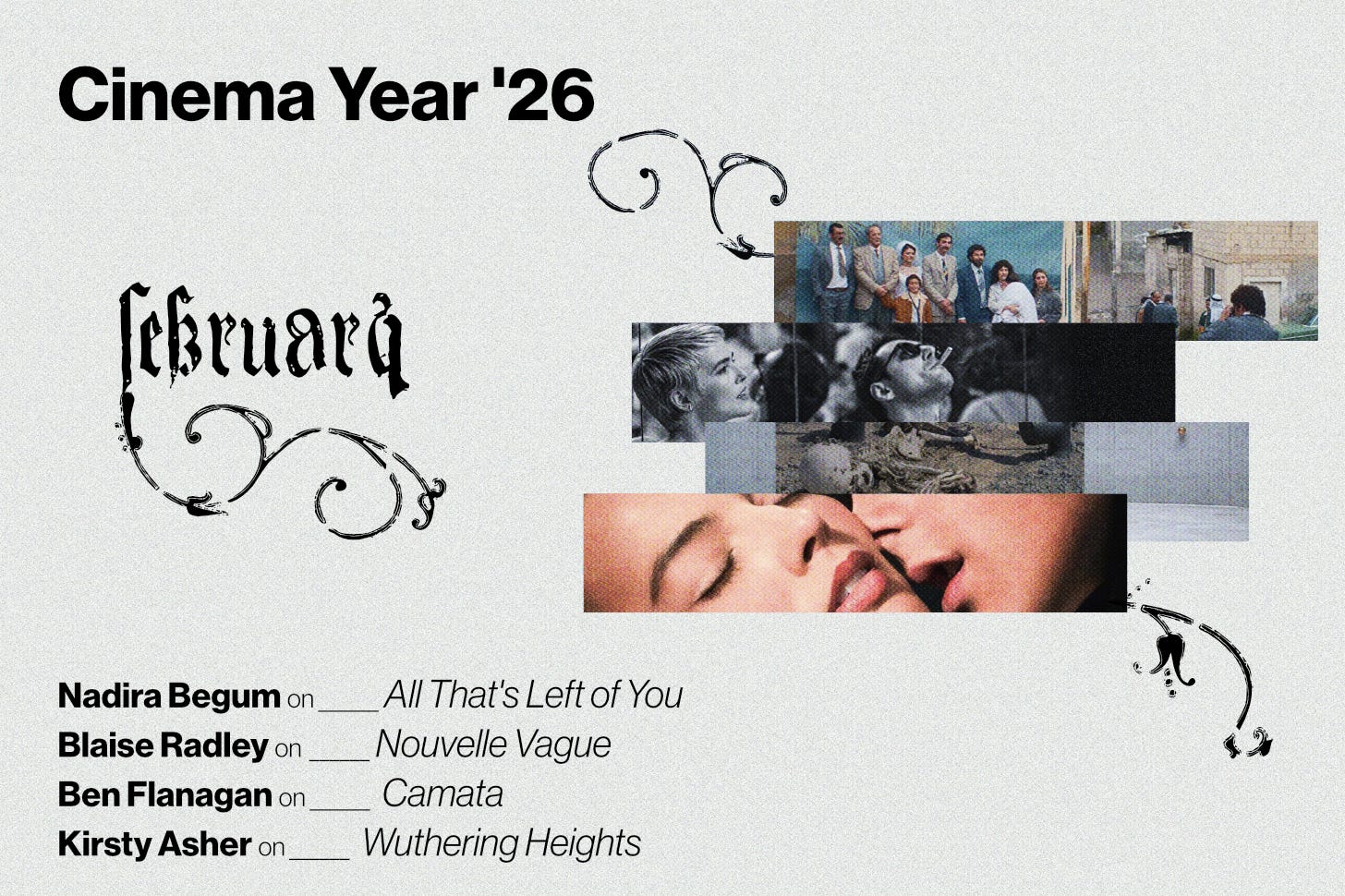
Welcome back to Cinema Year ‘26, our monthly review supplement. This month’s selection includes four features of renewal, films that in some way remake or reconfigure past historical images to signal the frightening political present.
Don’t forget to subscribe to receive this and more film writing direct to your inbox.
NOT BY LYNCH continues on Friday, 20th March at The Cinema Museum with Carnival of Souls (1962). Tickets are available now.
All That’s Left of You (Cherien Dabis, 2025, Palestine/Jordan)
An astounding span of history drives director Cherien Dabis in All That’s Left of You. With a story that spans more than seventy years, Dabis—whose eye for a carefully crafted shot has never felt more keen—has created a sweeping historical epic that acts as both archival documentation of a brutal occupation, and a tale of survival in the face of relentless persecution. Any notions of Palestinian suffering as a recent occurrence are refuted here; the violence didn’t begin three years ago, it began more than three generations ago.
Seventy four years of struggle, joy, and resistance are masterfully woven into this tapestry of Palestinian history, from the Nakba in 1948 to the modern day. The film focuses on a father and son, Sharif and Salim, played across the generations by Palestinian cinematic legend Mohammad Bakri and his two sons, rooting the film’s fictional familial bonds in real ones. The recent passing of Mohammad Bakri brings a solemn profundity to the film—it’s hard not to see his performance as a culmination of his life’s work, a grandfather of Palestine bidding farewell.
Memory, grief and nostalgia are intertwined as we bear witness to tragedy. The burning of Jaffa’s famed orange orchards (“Queen Elizabeth ate our oranges,” Sharif declares), news reports of ground assaults, and a child’s account of the Deir Yassin massacre punctuate this story of a family’s determination to remain in their homeland while bearing witness to its destruction. When Salim returns to Jaffa, now unrecognisable as modern day Tel Aviv, it’s a moment weighed down by the immeasurable grief of all that has been lost. “These used to be our homes,” he laments as he gazes forlornly into a soulless trinket shop.
All That’s Left of You is a breathtaking work of art soaked in poetry and resistance. It’s occasionally hampered by didactic dialogue, but after years of non-stop bombardment from a violent military occupation, a desperation to inform the world of such travesties is to be expected. Dabis’ aim is clear: for the audience to acknowledge, celebrate, and mourn all that Palestinians once had. So, as film festivals censor “political” (read: pro-Palestine) speech, and institutions cave to the demands of pro-Israel lobbies, seek out this film—it’s a defiant act of resistance that affirms a history of Palestine which the Western film industry seems eager to ignore. Nadira Begum
Nouvelle Vague (Richard Linklater, 2025, France/US)
Back when Nouvelle Vague premiered at Cannes, the prospect of Richard Linklater tackling the French New Wave mythos sounded woeful—coming, as it was, off the back of an uncharacteristically turgid run. Where those filmmakers broke free from convention, ushering in a new era, Nouvelle Vague seemed indicative of the modern state of arthouse cinema: backwards-facing and insular. Another ageing auteur preaching to the choir.
It brings me no small pleasure, then, to say that I was wrong. With the one-two punch of Blue Moon (2025) and Nouvelle Vague, Linklater has rediscovered his knack for spry pop philosophy, taking hackneyed biopic material—make no mistake, both of these films feature scenes in which a middlebrow easter egg is pointed to loudly and at great length—and nevertheless finding a heart and rhythm therein. Nouvelle Vague, in particular, toes the line between earnest and irritating, depicting a young Jean-Luc Godard (Guillaume Marbeck) as committed, even brilliant, but overflowing with artistic pretensions that readily rankle those around him.
It’s that grinding creative process that gives Nouvelle Vague much of its meat and humour. The narrative follows a simple forward march through the inception and production of Breathless (1960), but in the clashes between Godard and his producer, and Godard and his lead, and Godard and… his world, Linklater scratches at the veneer that arthouse cinema’s most beloved iconoclast has accumulated in the decades since. Godard’s endless quoting of philosophers and canon filmmakers, for example, at first appears to be pure affectation—but the moments where Jean Seberg (Zoey Deutch) imitates his po-faced delivery and he cracks a smile, or when the quotes seep into the “script” for Breathless, reveal a director who wasn’t just constructing a film in real-time, but a sense of artistic self.
Still, some frustrations do emerge by the nature of Linklater’s character behind the camera. Where Godard extols the virtues of spontaneity and friskiness, of cinema as full of revolutionary possibility, Linklater’s images are mostly pretty; orderly; patient. And yet even in these moments of seeming aesthetic conflict, the result is energising. Because how else did Godard discover his drive to sit in the director’s chair, except through observing such tensions himself? The New Wave may have long since crested, but the industry-wide drawdown we’re living through raises the prospect of small-scale art being truly antagonistic again. Could it be that there’s still another way? Blaise Radley
Camata (Pierre Huyghe, 2024, France)
Pierre Huyghe is interested in filming uncanny and inanimate human forms. Often statues, or a monkey in a mask, as in his most regarded short, Untitled (Human Mask) (2015). Camata, a feature length work, is currently playing in The Bourse de Commerce Rotunda. In this vast, domed room, Camata screens to a few long benches half-filled with TikTokking tourists and bored fashion students.
Pierre Huyghe’s 100 minute film spans across a night and day in the Atacama Desert in Chile, where machines study the skeletal human remains of an unburied body. They are equipped with cameras which survey the scene, edited in an algorithmic pattern unknown to the viewer. The programme note describes these machines as performing a ‘ritual’. If they are, they know nothing of it.
The image itself has a hyper-clarity not unlike that you would encounter in a high frame rate Dolby screening of Avatar: Fire and Ash. Cameron’s Prometheus-like hunt for new technology is one of many tendrils that has led contemporary humanity down the dark, dehumanising path of artificial intelligence.
As corny as ‘machine-learned editing’ is (we have enough Heated Rivalry fancams without them taking up major gallery spaces too), I found something aesthetically satisfying about watching the camera scan up and down a skeleton, the light captured with vivid contrast on that HFR camera. Yet the medical, mystical, environmental connotations of the sequence are undone when one knows that nothing sits behind the filmmaking apparatus to feel any regard toward its own gestures.
I’m not sure it’s achieving anything that, for instance, Michael Snow didn’t before with his literally-nauseating spinning cameras. If you feel so inclined at the Bourse de Commerce, your eyes can leave the screen to look up to the ceiling at that interior mural (completed 1889): four seasons, depicting France’s global expansion during the industrial revolution. Fitting, then, that it all leads to Camata: art for a machine’s sake. Ben Flanagan
Wuthering Heights (Emerald Fennell, UK)
Emerald Fennell continues to make films with the finesse of a small child bleating “Mummy! Daddy! Watch!” before backflipping off a sofa face first into the Axminster. The burgeoning hallmarks of a Fennell joint are all here: paint-by-numbers dialogue and screenplay; derision of the lower classes; hellish costume and production design to hollow out your corneas. But I am almost relieved by Wuthering Heights’ flat conformity, compared to the empty provocations of Promising Young Woman (2020) and Saltburn (2023).
Wuthering Heights is a story of cruelty and generational trauma which today might only be found in the pages of a social worker’s case file. In many ways, it is a testament to how isolated communities before the Welfare State suffered so catastrophically at the hands of a patriarchal class system. Nevertheless, the ossified cultural significance of the names ‘Cathy and Heathcliff’ overbears all of this, and for Fennell this has resulted in a bizarrely tender-hearted, traditionally romantic outing which manages to circumvent all of the novel’s most challenging themes. Rather than two almost-siblings whose fierce bond is forged in the wild Moors and then cracked by class divide, race, and each other’s learned cruelty, Fennell’s Cathy and Heathcliff are star-crossed lovers whose entwined souls are cruelly ripped apart by unfair happenstance and the interference of Cathy’s servant and nursemaid Nelly (Hong Chau). It is a ridiculous misreading of the source material, but Fennell’s ideas are at this point seemingly beyond an editorial eye.
I’ve seen this film dismissed online as ‘Mills & Boon cinema’ but having actually flicked through a couple of M&B’s in my time, they at least have some honest to goodness filth within their blousy pages. It begs the question of whether the frothing early test screening reactions resulted in a toning down of the final product, which is neither particularly provocative nor abrasive. Kirsty Asher