

Cinema Year '26: July
Blue Heron / The Napa Boys / Rosebush Pruning / The Odyssey

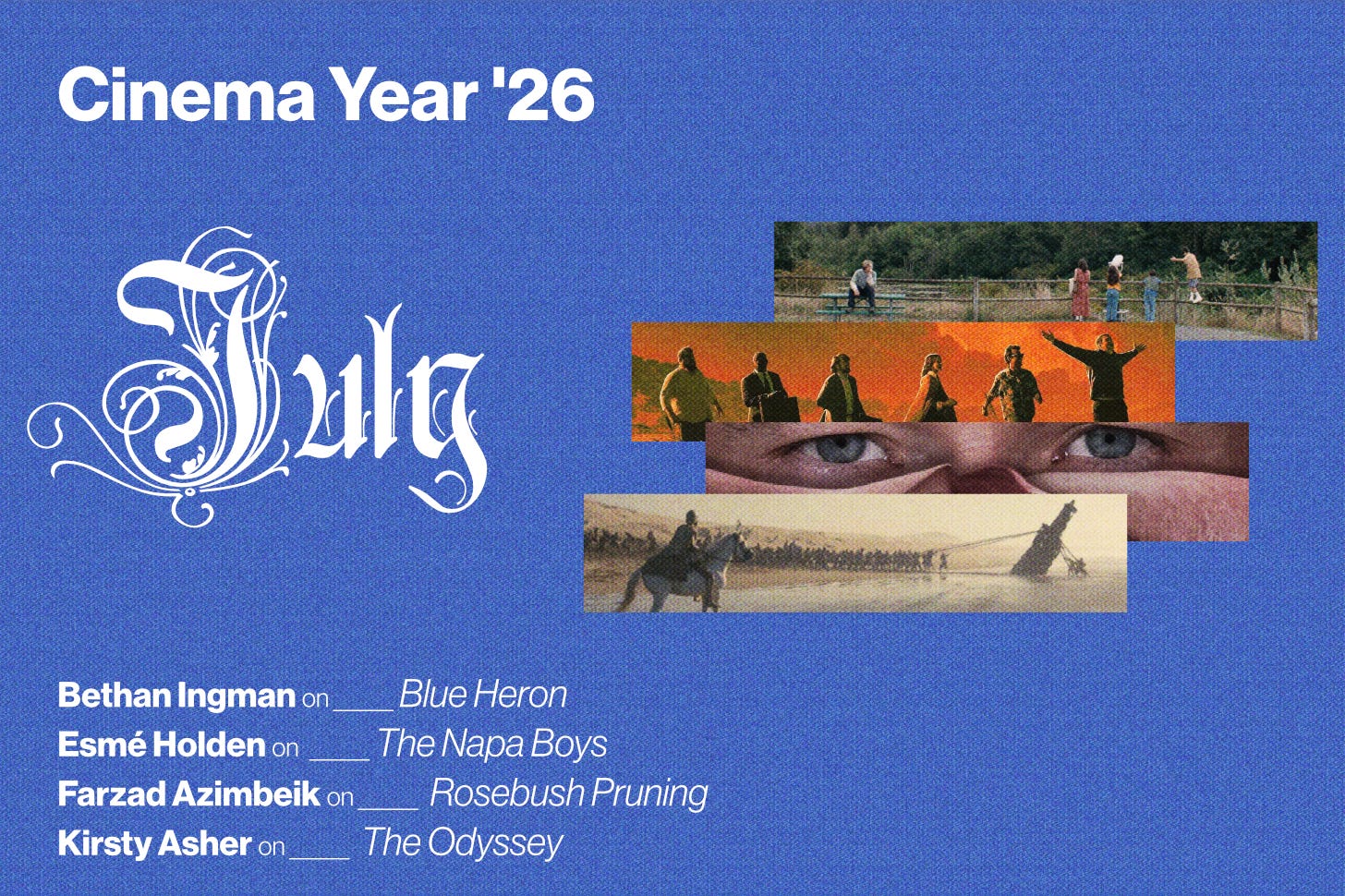
Welcome back to Cinema Year ‘26, our monthly review supplement. This month we remembered summers past, entered a wine competition, ate the rich, and defied Zeus’ law.
Don’t forget to subscribe to receive this and more film writing direct to your inbox.
Next Saturday, 8th August, we launch our new issue TOTALLY SPIES at The Castle Cinema in Hackney with a screening of Roy Orbison confederate-spy caper The Fastest Guitar Alive. Tickets are available now.
Blue Heron (Sophy Romvari, Canada, 2025)
Whilst John Berger was not describing cinema when he said that “the relation between what we see and what we know is never settled”, a resonance can still be heard. Filmmaking, as an optical medium, has continually grappled with the sufficiency of seeing. This quandary is no clearer than in Sophy Romvari’s feature debut Blue Heron. Joining a pantheon of contemporary films that use the personal archive to interrogate memories—from home videos in Aftersun (2022), to the buried history in The Secret Agent (2025)—Blue Heron similarly frames childhood memory through the lens of recollection. However, unlike Aftersun, where the director surrogate is able to reconnect with her father by revisiting his home videos, Romvari instead uses the representation of childhood memory to unsettle the idea of filmmaking as a route to understanding the past. Her depiction of the past opens with an image of a phone screen recording a landscape, pointing to filmmaking as an attempt at capturing a memory. This scene coincides, however, with a voiceover that admits that “those (childhood) memories are hard to trust”. Romvari, then, immediately indicates that filmmaking is a futile attempt at making a lost memory last.
Sasha (Eylul Guven), is the youngest child of a Hungarian-Canadian family. She spends her summer break playing with friends, going to the beach, and watching her parents’ increasingly hopeless attempts to understand her older brother Jeremy’s (Edik Beddoes) erratic behaviour. Whilst we do often follow what Sasha observes of her family, Romvari traverses beyond her perspective by filling in conversations she would not have seen. We are able to access the secrets that Sasha can only listen to through a door. Despite this, the attempt to rectify her sight is continuously sabotaged by Romvari’s direction. The audience’s vision is littered with frames—windows, mirrors and cameras frame the screen. In particular, when her mother (Iringó Réti) decides to let the social services take Jeremy away, we see her through a throng of children and multiple windows. Whilst we are allowed to hear what she says, we cannot grasp a full view. A fixed point of sight is constantly resisted, even as the older and younger versions of Sasha attempt to settle it. By continually obscuring our vision, we are reminded that seeing—or reminiscing—is not a gateway to understanding.
But, in the last scene, as we loop back to where we began, we are taken back to Sasha’s instinct to film the view. Unlike the opening, where the act of filming is shown alongside the inability to properly remember, this scene shows the value in still attempting to remember anyway. In repeating this scene, Romvari reveals the way new meanings can be excavated from the continual watching, recollecting and reenacting of memories. Whilst we cannot fix a moment in time into place, we can still find new ways of understanding through retrospection. And filmmaking remains one of the best tools to attempt it. Bethan Ingman
The Napa Boys (2025, Nic Corirossi, USA)
Of all the irony-poisoned hate-letters to cinema—Freddy Got Fingered (2001), Tim & Eric’s Billion Dollar Movie (2012) and, to a lesser extent, They Came Together (2014)—The Napa Boys (2025) is certainly the latest. Nic Corirossi’s work seethes with contempt for all the hacky conventions and embarrassing short-hand that have built up into the bizarre and stupid idea of what a movie looks and feels like. And these are at their most condensed and craven in the kind of direct-to-video sequel-come-spin-off that The Napa Boys is directly riffing on.
Conceived (and originally titled, before some serious legal advice) as the “fourth sequel” to Alexander Payne’s middle-brow classic Sideways (2004), The Napa Boys is imagined in the style of the late-era American Pie Presents series featuring none of the original cast (the latest of which, would you believe, came out in 2020). The only real connections left to the Payne source are the titular frat boy crew’s inexplicable passion for wine and their number plate referencing the original’s most relentlessly quoted moment: IH8MRLT.
The crew—whose name is repeated, like much else in the movie, with comic redundancy; as if we all already know and love them—are reunited upon the call of the mystical sommelier (via his amulet, if you were wondering) for a quest that’s both loosely plotted and utterly contrived. Corirossi’s main strategy as director (and actor, playing the Stifler-esque Jack Jr) is to play a conventional scene out with blunt artlessness; the completely artificial romances, all of which occur after seconds of shared screen time, and the most disgusting frat-boy banter, are rendered in the same passionless shades.
It self-consciously peaks early in a scene where Jack Jr accidentally takes both laxatives and dick pills and can’t find a place to shit and cum except… well, a barrel of wine that’s about to be entered in California’s most prestigious competition. Running out of steam is actively weaponised: an hour and change into the movie, its nominal plot is over, but The Napa Boys ambles on for another twenty-five minutes, pulling on some of its most absurd threads and contriving new ones simply to see how long they can keep you watching. Because, whether you walk out or stay, the joke is on you for spending your brief time on this Earth doing something as fucking pointless and stupid as watching a movie. Esmé Holden
Rosebush Pruning (Karim Aïnouz, 2026, UK, Spain)
Rosebush Pruning is a perfect example of homogenous contemporary arthouse production, in which respect for the humane has been neglected for the sake of meaninglessness. Its superficiality begins with its lazily metaphorical title, suggesting that family is a rosebush: beautiful but with thorns. Pretentious and chaotic to its core, director Karim Aïnouz’s latest film is an aimless probe into the realm of the wealthy. Its premise seems intriguing: a decadent rich family falls into bloodshed after discovering an incestuous secret from within the household. This exotic dark-side-of-the-rich exposé unfolds as we listen to Ed’s (Callum Turner) supposedly shockingly revealing voicetapes.
Inspired by Fists in the Pocket (Marco Bellocchio, 1965), Rosebush Pruning feels like a careless and horrid homage to the Italian masterpiece, one that seems more in hock to Lynchian dreaminess, or the complex cruelty of Pasolini. In the kitschiness of both the script and images, Rosebush Pruning takes its sensitive subject at face value and throws in a bunch of discomforting moments without moral care; for instance, when Ed discovers that his father performs sex acts on a family member as a bedtime routine.
Amid this hecticness there are a few merits to Rosebush Pruning. I enjoyed the character delivery of Ed’s sister, Anna (an amazing Riley Keough), whose strong sexual tendency towards her brothers is depicted in a frenzy. Ed’s love story is also a funny sub-plot. Having fallen in love with a Greek man he met on a beach–the film opens with them exchanging a couple of funny lines- Ed goes to Greece to find his lover after receiving an invite in the form of a dick pic. Here the joke works well since Aïnouz elevated the kitsch into a nihilistic practical pun.
Aïnouz, usually a reputable filmmaker when filming in his homeland Brazil, has turned a spineless story into one of the worst productions of this year. Rosebush Pruning craves to be yet another mimicry of how money corrupts, instead affirming that ‘money is power’. It sanctifies trendism and defends the rich in not taking responsibility for their choices and actions. Rosebush Pruning is kitsch, it wants to criticise the high-flying society but eventually celebrates their bloodsheding hedonism. Farzad Azimbeik
The Odyssey (Christopher Nolan, USA, 2026)
The opening line of Homer’s Odyssey is a request which is gladly accepted, to tell a story of a complicated man, in an ancient world. The knowledge that a story will instil wonder, or sadness, or inspiration, is analogous to the human condition. But those who commit their lives to storytelling do so as much for themselves as for their audience. Blockbuster entertainer he may be, but Christopher Nolan also embarks on his large-scale feats of cinematic marvel as a means to validate his artistic purpose, his political ideals, and his cultural significance.
In The Odyssey, the fraught political grievances that made land in Nolan’s previous works, notably The Dark Knight (2008) and Oppenheimer (2023), reach their home shores. Indeed, Nolan’s centrist guilt over imperial violence provides a surprisingly compelling twist and turn to the ending. The cunning, decorated hero is confronted with the grim reality of his underhanded Trojan Horse and the sacrilegious violence wrought on the city.
Nevertheless, Nolan’s style sits uncomfortably with the mythological premise. His formality of form, an executive smartness, works in strong tandem with the contemporary American settings of Inception (2010) and Tenet (2020), but here it rubs puzzlingly against such a grand old tale, particularly stark in the informal American English line delivery that does little to invoke the mythical. Likewise, the costume design is fairly uneven: Charlize Theron appears to be modelling a Malibu beachwear brand, while the Achaean armour is dourly accurate compared to the sci-fi coded chrome helmets of the Trojans. The main highlight of this tale is Samantha Morton’s Circe, whose birdlike fragility creepily belies her power as she physically contorts Odysseus’s men into pigs, like putty in her hands.
It seems hard to imagine where Nolan could go from here. Between this and Oppenheimer, he seems less a man of twists and turns and more a man ready to sail for the sunset. He has given himself to The Odyssey, and the audience have rewarded him with the box office results. What will you sing of now, Muse? Kirsty Asher