

Cinema Year '26: March
Return to Silent Hill / A Pale View of Hills / How to Make a Killing / Everybody to Kenmure Street

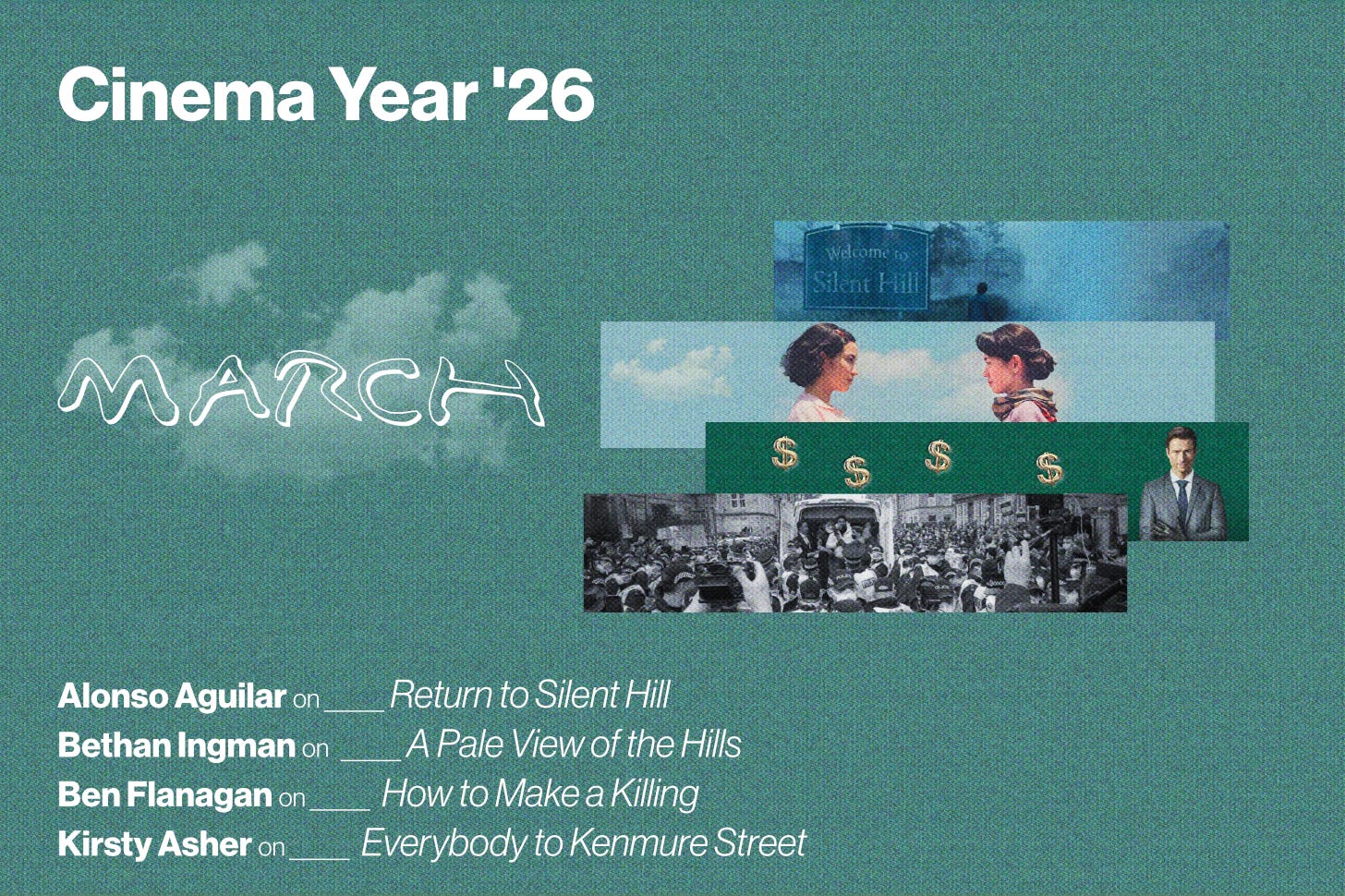
Welcome back to Cinema Year ‘26, our monthly review supplement. This month we caught up with PS2 surrealism, a striking Ishiguro adaptation, Glenn riffing on Ealing, and a document of vital community activism.
Don’t forget to subscribe to receive this and more film writing direct to your inbox.
NOT BY LYNCH continues on Wednesday, 22nd April at The Cinema Museum with Celine & Julie Go Boating (1974). Tickets are available now.
Return to Silent Hill (Christophe Gans, France / USA, 2026)
Cinematic Impressionism has been difficult to pinpoint. Considered more of an impulse than a method; a way of doing and experiencing guided by affection and spirituality instead of prowess and rationale. From Gance to Dulac, each filmmaker understood this differently, with their own unique way of manipulating the film image as an open inquiry towards transcendental truth.
The Francophone impressionists posited that aspiring for this meant revolting against the narrative paradigms of commercial filmmaking, embracing the erratic swings of symbolism and the exalted subjectivity of poetry. Their existence within the auteurist framework is in that sense a point of contention, precisely due to their unfathomable qualities, spectres of a bygone era of esoteric image-making. Christophe Gans’ Return to Silent Hill presents a counterpoint, a sort of aesthetic séance that looks to connect the oneiric logic of the 1920s to the jagged digital pixels of the Sony PlayStation 2 era.
The clunky videogame dialogue and top-down camerawork are indeed first experienced as a jarring affront to cinematic conventions, but as the film’s Gothic atmosphere becomes more and more pervasive, Gans double downs on the uncanniness as an expressive form to fully inhabit a sort of liminal space between mediums. After all, he’s working with one of the most revered source materials in the history of videogames, one of the pioneering exhibits of the “videogames as an artform” banner: Masashi Tsuboyama’s Silent Hill 2 (2001).
Just by itself, merely attempting to touch such a cultural touchstone will inevitably draw vitriol from purists, which isn’t helped by the fact that Gans goes even further: not trying to retell Silent Hill 2, but embody it. Like the impressionists before him, he molds cinematic power towards capturing the essence of subjects, and then being consumed by them. The film’s visual grammar intertwines kitsch digital textures and grotesque practical imagery, artificial camerawork and abrasive, Nu-metal editing choices as an open inquiry into protagonist James’ tortured psyche as he looks for lost lover Mary and confronts the myriad of manifestations of his dark past.
More than a narrative, Return to Silent Hill is an overflowing nightmare. Hallways change as soon as they are crossed, walls are in constant collapse and from their hubris rise harrowing constructs of projected guilt and rotten flesh. It’s disorientating while doomladen. Oppressive while mournful. Always elusive. Only an unrestrained maximalist like Gans could come up with a thing such as January-release photogénie. Alonso Aguilar
A Pale View of Hills (Kei Ishikawa, Japan / UK, 2025)
Kei Ishikawa’s A Pale View of Hills is largely faithful to its source, Kazuo Ishiguro’s debut novel of the same name, except for one key difference - the perspective from which we are told the story. By framing through the daughter’s interrogation, rather than the mother’s recollection, the film diverts away from the novel towards a plot that seeks to uncover the secret of the past. Letters, postcards, and photographs are closely examined as evidence of the mystery tucked away in Etsuko’s past. Much is dedicated to Niki’s search: her investigation of the house, her confrontations with her mother, her desire to write about Nagasaki. But this feels ceaseless when the film is devoted to telling us secrets without us even beginning to ask.
Everything is spelled out - we know exactly what happened to Keiko, Etsuko’s older daughter, because Niki tells us: ‘she’d hung herself, all alone up there’. We know that it happened in her room. We know that Etsuko shies away from discussing it. The mother slaps the daughter for saying that she is ashamed. Violence intrudes like the flashes of light protruding from the estate agent’s camera in Keiko’s room - sudden, sharp, and all on the surface.
Ishiguro’s writing is at its best when it exposes and restrains, in equal measure, the violence of his characters. Ishikawa’s direction, instead, transforms restraint into pure, showy action. By ending with a montage that makes Etsuko’s secrets exceedingly clear, Ishikawa takes away our readerly delight in uncertainty, thereby removing any dread that could have been left to linger. Bethan Ingman
How to Make a Killing (John Patton Ford, USA, 2026)
The arc of Glenn Powell’s stardom is long but it bends towards justice. A year ago, he was the anointed one, a Cruise mentee whose not-so-ironic chad energy had him earmarked for A-list phenom. But a sequence of disappointments, including an unloved Running Man remake and a Hawk Tuah-cameoing Eastbound & Down rip-off have damaged the Texan. Take his latest, How to Make a Killing: is Becket Redfellow an incel? Sociopath? Socialist? We cannot know because Powell doesn’t either.
Per Wikipedia, it’s “loosely inspired” by Robert Hamer’s Kind Hearts and Coronets, though to my eye How to Make a Killing is a fairly straightforward remake. In lieu of Alec Guinness’ elite Klumping (the practice of playing multiple family members in a single film), Patton Ford casts a range of character actors, including Bill Camp as a finance mogul, and Ed Harris as a sinister patriarch. The doofus amateur photographer Henry is updated to become a downtown New York hipster (Zach Woods).
It’s a parting shot in the Eat The Rich cycle of social satires for the ‘gestures at everything’ crowd in Hollywood, which broadly started with the success of Parasite. This one doesn’t have much to say on what the interplay of wealth and class in America does to a person, relying on a series of affectations associated with supposed good filmmaking. Patton Ford rattles through scenes as a sequence of depersonalised zooms early PTA’s Magnolia; frantic scenes in grotty locations like a prison, or New Jersey, recall the Safdie-verse; a mansion’s closed gate is answered with a threatening typewritten letter à la Eyes Wide Shut. The simple symbolic elegance of Kind Hearts & Coronets’ hunting/beartrap denouement is injected with some green de-ageing substance, so it becomes a cat-and-mouse rifle chase through a billionaire’s mansion.
One can’t help but feel sorry for Powell. It seems the harder he tries to relate to mankind, the more bland his performances become. I wonder, is this sympathy the marker of some star quality, after all? Ben Flanagan
Everybody to Kenmure Street (Felipe Bustos Sierra, UK, 2026)
The documentaries of Chilean-Belgian, Glasgow-based director Felipe Bustos Sierra bring hope to his leftist-liberal British audience. His first feature, Nae Pasaran (2018), about the Glaswegian unionised factory workers who stalled production of fighter jets being sent to support Pinochet’s fascist dictatorship, used its interview subjects to hone in on the nitty-gritty of what leftist politics means, and what they can achieve, which perhaps also narrowed its audience. It follows a certain logic that his second feature-length doc should expand on these Scottish social and political connections, to highlight a more recent example of the collective action and solidarity needed for a successful political movement: the 2021 protest against the attempted Home Office deportation of two Sikh Indian men in Glasgow’s Pollokshields neighbourhood, in his latest film, Everybody to Kenmure Street.
Bustos Sierra plays to his strengths by engaging the ordinary people who participated in the protest as the majority of his interview subjects, some who were there from the very beginning as neighbours on the street. Where this isn’t possible for sake of anonymity, well-respected British thesps recreate their parts verbatim in solo reenactment scenes. One particular British A-lister, in a gender-swapped role, reenacts the person who, incredibly, managed to slide under the Home Office van in the early stages of the deportation, wrap their arms around the axel and remain there for the endurance of the protest, preventing the men from being deported. Archive is cheekily employed, with footage of a comrade rolling a water bottle under the van, and a mystery hand reaching out from under the bumper to snag it. By adhering to a straightforward chronology of events, Bustos Sierra brings to life what those who followed the protest in real time on social media could only glean in part, and in doing so heightens the stakes.
Despite its stirring content, there are puzzling gaps in Bustos Sierra’s process. The only interviewee to receive a name card is the firebrand lawyer Aamer Anwar who is parachuted in to save the day. This leaves the film at times absent of some very necessary context, like formally identifying in archive the legendary Glaswegian trade unionist Jimmy Reid, whose still-living daughter lives on Kenmure Street and witnessed the entire proceedings. The persistent attention paid to the Home Office and Priti Patel’s refusal to acknowledge the burgeoning situation, having caused the chaos in the first place, hints at an argument for Scottish Independence that is never fully explored.
As heartening as the story of this left-wing cause may be, one can’t help but note the concerning acceleration of far-right mobilisation in the streets that has occurred in the five years since. Everybody to Kenmure Street leaves the open question: would the results play out with such success today? Kirsty Asher