


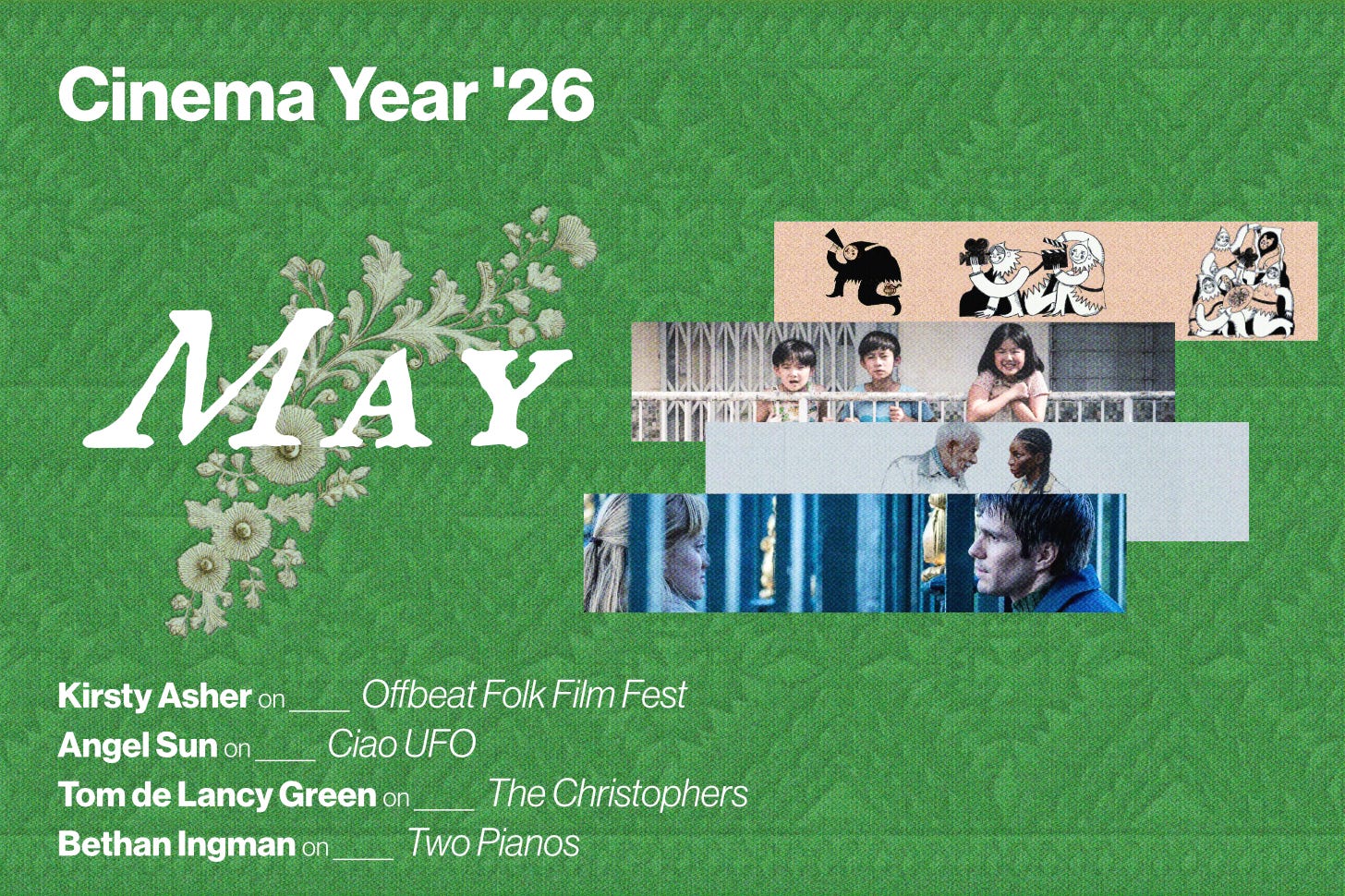
Welcome back to Cinema Year ‘26, our monthly review supplement. This month we took in a surplus of folk cinema, a pean to a lost Hong Kong, Soderbergh’s latest forgery, and Desplechin at his most conceited.
Don’t forget to subscribe to receive this and more film writing direct to your inbox.
NOT BY LYNCH continues on Friday, 12th June at The Cinema Museum with Spontaneous Combustion (1990). Tickets are available now.
Offbeat Folk Film Festival - Welcome to the UK (UK, 2025-2026)
Starting four years ago with slap-up screenings of niche BFI Archive films that explored British working class and folk culture, Offbeat Folk Film Club has now branched into an film festival which has recently completed its second edition. One screening, Welcome to the UK, feels particularly pertinent to Offbeat’s goal as a programming collective, and to the wider musings of the current folk ‘revival’: to explore the notion of a national British identity in a time of fraught political upheaval.
Music for Prawn (McD, 2026) follows a mute papier-mache headed individual named Prawn around the Medieval Music in the Dales festival. There he is taught how rural bagpipes are created from the body of a goat, is serenaded by countertenor David Yardley, and educated on contemporary medieval dressmaking. It’s a fun jaunt, although perhaps a bit too irony-pilled in its execution. W: A Return to Oz (Howard-Baker, 2025) adeptly fuses archive of defunct Plymouth rave project The Warehouse with his own footage of its present abandoned state to track the glum decline of British rave culture since the 1990s.
Merrie England (Robinson, 2026) examines the uncertain and often misunderstood origins of English folk custom in response to the nationalism of Raise the Flags. While engaging, it is mostly highlighting paths already well-trod in this national conversation. Music For Waltzers (Carson, 2025) may well be the stand-out of the programme. A childhood passion for the Waltzer fairground ride and its musical accompaniments of jungle, gabber and dubstep leads Carson to uncover a previously unsung world of British carnival culture, replete with DJs and hardy ride workers, and even a Waltzer worshipper. Must be seen to be believed! While You Wait (Stockman, 2025) captured the audience’s hearts at the programme’s close - a delightful short about a Sussex hospital radio station, one of the longest running in the country, and boasting potentially the country’s oldest radio DJ on its roster. Within the programme’s context it presents volunteer-run radio as a vernacular tradition, a fascinating concept that echoes in the festival’s burgeoning wave of filmmakers interested in capturing contemporary folk practice and vernacular tradition in the UK. Long may it continue! Kirsty Asher
Ciao UFO (Patrick Leung, Hong Kong, 2019)
Despite what its title may suggest, Ciao UFO is not a sci-fi film, but a tender, highly local portrayal of Hong Kong’s collective memories from the 1980s to the early 2000s. It follows the lives of four childhood friends who witness what they believe to be an extraterrestrial event, and gradually drift apart as they enter adulthood. Struggling in their late 20s, they have to revisit their past in order to solve their current life challenges.
In the original Chinese title Zoi-gin UFO, the Cantonese phrase Zhoi-gin, like “Ciao”, carries the double meaning of ‘goodbye’ and ‘see you again’. The UFO thus symbolises a farewell to, and a revisiting of, something that has been lost and is still longed for, including Hong Kong’s past.
Accordingly, the film vividly captures Hong Kong society during major events including the stock market crash and the city’s return to China. The protagonists’ lives form a microcosm of Hong Kong society, where individuals are told to pursue stability and financial success, while feeling lost in, and pressured by, the city’s rapid changes.
However, the link between the characters’ prospects and Hong Kong’s changing climes is held back by its weak storytelling. The UFO bonds the friends and recalls their brave, innocent younger selves, serving as a potent link between the loss of childhood purity and the city’s changes. Yet, such depth is limited by overly explicit dialogue about courage and imagination, and the cliché plot of grown-ups disheartened by their current lives looking to rediscover their “true” selves.
Despite its success in Hong Kong, whether Ciao UFO will resonate with international audiences is more uncertain. Culturally-specific references in the soundtrack’s lyrics and the characters’ favourite TV shows are not translated or explained, preventing some from sharing the sense of nostalgia that provides much of the emotional weight of the film. Its wistful depiction of Hong Kong remains a poignant reflection on a city struggling to reconcile its past with an uncertain future. Angel Sun
The Christophers (Steven Soderbergh, USA/UK, 2026)
The Christophers is a fidgety film, ratty like a moth-eaten scarf, and a marble run of inconsequentialisms. Tension is cranked down rather than up in this misshapen two-hander about a notorious bad boy artist (Ian McKellen) and the forger (Michaela Coel) sent to finish a series of romantic portraits for his grubbing children to sell on when the old man kicks it. McKellen looks as though he might melt, yet grips his silences with the pregnant threat of vindictive bitchiness. Coel is diligent, but terse and sharp. She makes just as much art out of a serrated cheekbone as any painting she produces in the film, and her spoken g’s and k’s punctuate the musty air within the unkempt, gloomy bombsite of the former’s Bloomsbury townhouse like hailstones on corrugated iron.
Steven Soderbergh assists the leads in reviving the two-shot, long forgotten in the wake of the streaming service’s ultra-legible chain-link editing. The camera’s movements stay contracted and tense in London’s post-Millennium exteriors, but once inside the older house, Soderbergh, operating his own camera, floats aquatically as he did for last year’s Presence, drifting up staircases and around corners. He is known post-retirement for being weaselly and spry like Coel’s forger, taking people’s money and running with it, but it’s obvious Soderbergh most sympathises here with McKellen. Like the camera, the thespian is allowed to dodder, half beginning sentences with a charming elderly stutter.
According to McKellen, rehearsal time was minimal: too much polish would spoil the effect. The film is tiny by design, sighing and sauntering, only coming alive in more recognisably ‘Bergh-ian fashion when Soderbergh reminds the audience of his youthful punchiness with an image he loves returning to: stolen goods in the back of a van. Even so, for a quasi-heist film, Soderbergh pulls back at each new revelation, like air out of a balloon. Strangely, it’s the oldest person in the room, McKellen, that keeps the maverick director’s energy up. Tom de Lancy Green
Two Pianos (Arnaud Desplechin, France, 2025)
Arnaud Desplechin’s films have a novelistic nature. Desplechin himself categorises his work as the product of an ‘unaccomplished writer’, of which his latest addition, Two Pianos, is no different. Following pianist Mathias’ (François Civil) return to Lyon from Japan, lured by mentor Elena (Charlotte Rampling), he encounters a child in the park who bears a striking resemblance to himself - who, it is revealed, is the son of his former flame Claude (Nadia Tereszkiewicz). What follows is a carefully scripted melodrama depicting unrequited passion and quiet anguish.
Despite DOP Paul Guilhaume’s intimate handheld camera, Desplechin approaches the melodramatic torment of the characters with an emotional restraint. The characters are entrapped in a cycle of internal pain that bears itself in the film’s most striking images - an elevator door closing on Mathias’ collapsed body, a child fallen on the floor of a playground, a young widow telling a risqué story at a funeral. When Claude’s husband Pierre (Jeremy Lewin) suddenly dies, we are only shown the paramedic’s attempts at resuscitation of his dead body. In this film, lifeless bodies proliferate, like marionettes with their strings undone.
By rendering the action off-screen, Desplechin circumscribes any emotional interiority for the characters to an unreachable arena that the audience is not granted access to. Novelistic detail conspires to keep the inner emotions of the characters unspoken and unexplained whilst refusing to delve beyond the surface. All we are left with is the after-image of an unlocatable interiority that we can never grasp.
By stripping the film of any discernment - for the audience and director alike - we are left in the lurch, spinning endlessly in the rumination of events. In clothing the characters in a veil of indecipherability, Desplechin fails to depict the human interior inside the lifeless shroud. Bethan Ingman