


NOT BY LYNCH returns to the The Cinema Museum on 4th September. Moving into the 2010s, the same decade as that magnum opus Twin Peaks: The Return, we have chosen to screen a film which perhaps buckles under the weight of its forebear: Under the Silver Lake (2018).
But first, read Graeme Arnfield’s piece on our 2000s pick, Michael Snow’s *Corpus Callosum (2002) + Sshtoorrty (2005). Graeme is a filmmaker and artist making research-led work on ecology, labour and technology. His first feature, Home Invasion, premiered at Berlinale, 2023. His most recent feature, The Case Against Space, premiered at Visions Du Réel, 2026 and received the Doc Alliance Prize at Cannes.
Tickets for Under the Silver Lake are available here, and come with a print booklet which includes the essay.
TOUGH BODIES
This year I’ve been painfully aware of being a body in a room. I fractured my shoulder falling over in Paris in January. It was an accident, something done to me, both by me and not by me. I was there to sit in a room doing the post-production on a new film. I was to be a body inside a workflow, managing the translation from one state into another, transforming all the intentions of a shoot into something coherent, deliverable, and financialised.
Through this, I have been thinking a lot about Micheal Snow.
I first came across Snow as a teenager. Taking that known path of first becoming a David Lynch obsessive, before being sent back to Deren, to Anger—I had read the descriptions of Micheal Snow’s films in that frenzy. Like Lynch, Snow was an artist whose work was both important in itself and as an idea. That you could slowly zoom into a photograph, endlessly pan across a classroom, program a robotic arm to move across a mountainside—all these things would be art, would be cinematic. Working between mediums in enviable fluidity, both would, in the latter periods of their work, embrace a digital abyss. I am thinking of Inland Empire (2006) and Twin Peaks: The Return (2017), of *Corpus Callosum (2002) or Sshtoorrty (2005). Works that act both as radical, forward thinking openings using new techniques and grammars and closing compendiums on lifetimes of preoccupations.
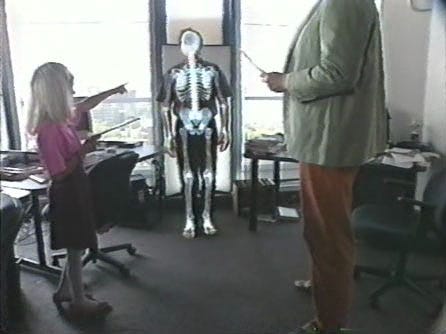
Asking what it means to be a body in a room, one that turns thought into action and action into thought, that makes meaning from the work it does, Micheal Snow’s *Corpus Callosum, his last feature length work, depicts the daily goings-on of workers in an unidentified tech office overlooking Toronto. Bodies in a room. It is a film of workplace drama—meetings, deadlines, a clumsy affair, company mandated exercises, violent abuses of power—captured as comic vignettes endlessly tracked across, left to right, by a slow and deliberate camera move. As they work, immaterial practical jokes befall the workers, phantomographical accidents done to and with them. A computer monitor zaps someone with a cartoon bolt of electricity, passing through their body into others. Two people sneak off to the bathroom only for their bodies to merge into an awkward geological slab, desiring bodies melted into strata. People smoke enough on their lunch break to turn into smoke itself. All these misfortunes rendered via gloriously digital effects —some profoundly goofy and others displaying impressive attention to the masking and blending of the real and artifice (think of the chasm between the charmingly homespun and the ultra high resolution CGI in Lynch’s Twin Peaks: The Return). Tellingly, these effects destabilise the workers but never fully upend work itself (what vague work that may be); pushed and pulled into new physical registers the staff simply return in the next cycle to act and be acted upon again. Provocatively, this might not be a film about dematerialised labour, but one at its most materialist: work both as something that you do and something that is done to you, work as an exhaustion that moulds you, that you take back with you to other rooms, those filled with other bodies also in the process of reconfiguration.
Recalling Nortel, the Canadian telecoms giant who, when the tech bubble burst in the 2000s, wiped a third off the Toronto stock exchange, leaving 60,000 workers unemployed, stripping pension funds, and netted its CEO a CA$135 million payout. This is the landscape of work that Snow was making *Corpus Callosum under. Watching in the present, we are reminded that office culture has changed a lot since 2002. From co-working spaces, hot-desking, Slack channels, employee monitoring software, to our embattled era of work-from-home discourses and the AI sloppification of work itself - new tools, same struggles.
Perhaps then it is useful to think of the film as a collaboration between an artist and industrial production, between Snow at the end of his practice and Side Effects Software, the Toronto special effects company who handled the digital accidents, at its beginning. The space between their intentions, between production and post, is where the film operates. On one hand, an anti-illusionary structuralist film on work and, on the other, a showcase of commercially applicable effects. In truth it is both these things at once, a critique and a demonstration, Berlinale Forum and Consumer Electronics Show. Throughout the film, we hear the constant muttering of off-screen direction, presumedly from Snow himself, choreographing these workers, telling them when to perform, when to hit their marks so that they can be mutated by Side Effects Software afterwards—a reminder that work makes us active participants in our own contortions. *Corpus Callosum was an early production for Side Effects Software who to this day provide versions of the tools used in the film to VFX companies contracted to places such as Disney and Warner Brothers—studios which fought against recent much-needed unionisation efforts in their contracted studios.
When I recall the film, the sequence I find myself reaching for functions differently than the rest. Unlike the side-on full-body tracking of the office, it depicts an elementary school classroom from above. Here the students are lined up grid-like on their individual desks, shuffling papers around, echoing the abstraction of atomised work of the adults. Slowly they notice the god’s eye camera. Debating what to do, turning thought into action, they pile their desks up high, changing their environment. Climbing their makeshift tower, they support each other’s ascent, bodies stretching for each other until one of them pulls the plug on the camera, on our gaze. This reconfiguration is achieved in the moment, not in post. There is no smooth tracking shot out of this sequence, no continuity via effects, it just fades out, never to return. There is a hope there. They are bodies in a room that can and must work together in order to have agency over the way they are rendered. The title of the film refers to the central region of tissue in the human brain which passes messages between the two hemispheres, the left and right, turning thought into action. In Latin, perhaps due to its particular material qualities, that part of the brain translates as “Tough Body.” These children, their actions, remind us we are tougher than we think. We are still bodies in a room that can work together. That meaning is something we do, that doesn’t have to be done to us. Thankfully my shoulder is no longer fractured; I remain a body in a room, a tough body. Graeme Arnfield