



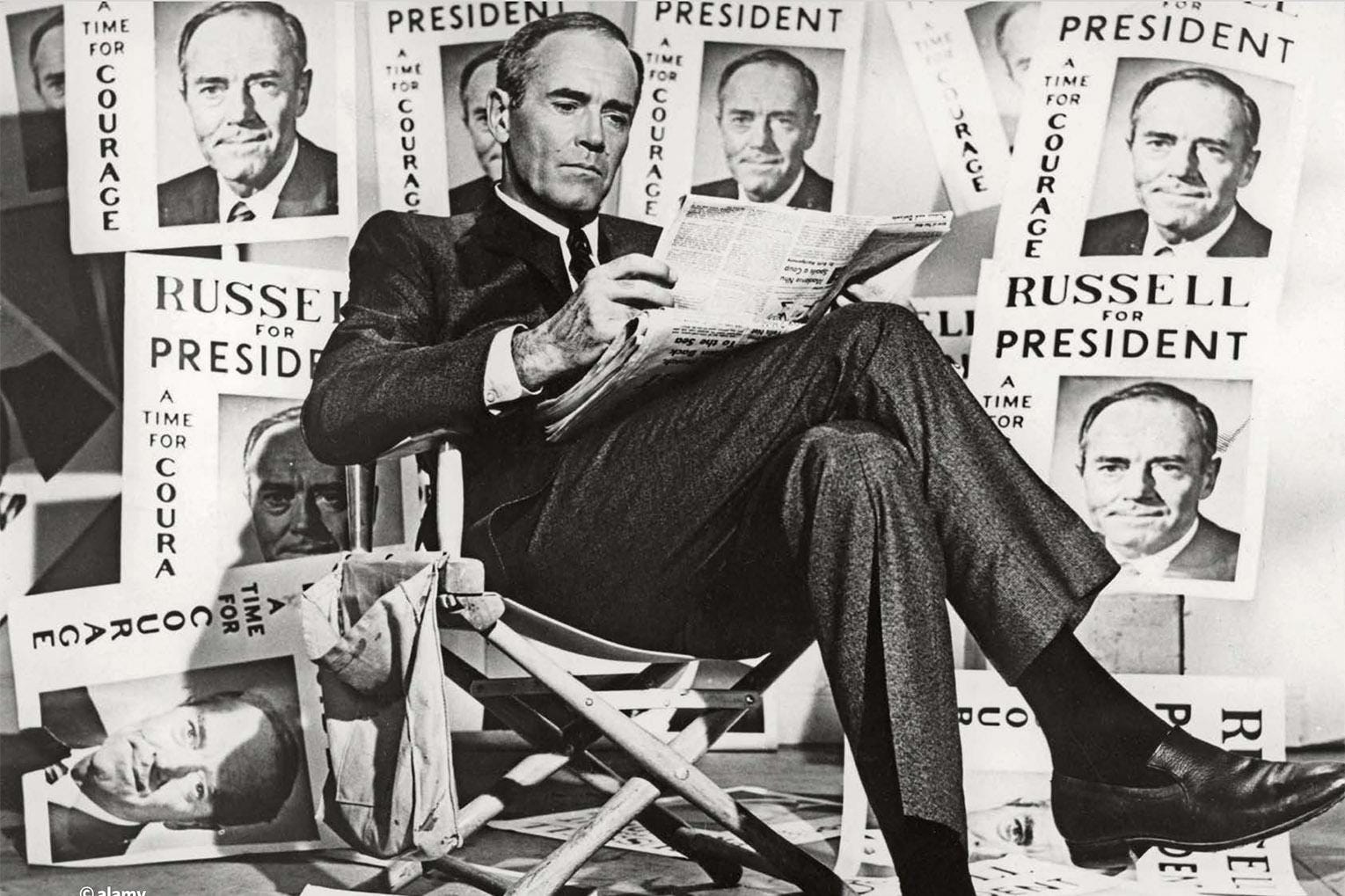
This week, Cinema Year Zero presents a lively and discursive two part essay from critic Anand Sudha on forms of auteurist criticism, via Alexander Horwath’s 2024 essay film Henry Fonda for President, which screened last week via Le Cinema Club.
And don’t forget that after our packed screening of Kiss Me Deadly, tickets are now available for Carnival of Souls on March 20th.
Ideas Take Flight: Auteurist Criticism and Henry Fonda for President
Part I: Brochures and Brickbats
A common approach to written essays on film auteurs (not necessarily directors) is essentially a journalistic one. Consider a “classical” approach to criticism along artistic lines, with a beginning, middle and end, that, contrary to Godard’s famous quote, are necessarily in that order. An airtight structure prevails even with backtracks and forward projections, functioning more as reinforcements of the “central” thematic preoccupations invoked in the introductory paragraph rather than jumps that disrupt the direction of the essay.
A biographical description follows from an introductory paragraph - the “hook” of the essay - which, at the very least, traces an auteur’s influences, artistic initiations and (shifting) reputations, setting up the reader for what they have been presumably waiting for – the description of the individual works in the auteur’s oeuvre. These descriptions are generally capsule pieces arranged chronologically, accounting for omissions of works that have slipped away from the critic’s grasp, generally due to the lack of availability. The length of these capsules are normally tied to the critic’s interest in that work, editor wordcounts, or both, but there’s little doubt that they adhere to a compressed version of the review format, beginning with biographical details that provide context for the nature and direction of the work followed by a plot summary, and a brief exposition of the themes, replete with echoes of the past and teasing calls to the future. Despite the frequent callbacks to the opening paragraphs, there is still the sense that these capsules are self-contained pieces which can even be detached from the overall essay for the reader interested only in the particular work, condensing the depths of a larger review while minimising time investment, like this thorough essay on Don Siegel by Lawrence Garcia.
This “brochure” quality of such essays does lend itself more easily as a guide for the uninitiated, but that doesn’t mean it’s devoid of insights, and its linear organisation does allow one to observe the evolution of an artist, similar to a curation based on timelines in an art gallery. These essays can also be viewed as compressed director studies, mimicking multiple books that follow a similar format with chapters accorded to each film, though these nested mini-chapters unfurl by the rules of the review, a format and style which I am guilty of perpetuating as well. But the concern that the introductory paragraphs serve as mere window dressing to the “meatier” capsules remains, as the theme often gets swallowed by the organisation and self-contained constituents, limiting associations and conversations between the works. Even when we consider the best examples of this approach, of which the aforementioned Garcia essay is certainly among them, the constituents corresponding to each film still feel detachable, rendering the essay as a collection of reviews contextualised by the introductory paragraphs.
This privileging of plot and linear structure smoothens all discontinuities, especially when elaborating on a director’s oeuvre through the prism of a particular theme. A rupture in an artist’s oeuvre that runs in flagrant contradiction to the main theme of the essay is dispensed with a single line or two before the gears of linearity chug the essay train forward, not even leaving them as “subjects for further research” (to borrow Sarris’ categorisation of auteurs). Stumbling blocks are mainly included for chronological continuity, seldom allowing the critic the space to reassess and reflect themes in light of these ruptures.

