

Josie and the Pussycats
Day IV at Cinema Rediscovered

Welcome back to Cinema Year Zero at Cinema Rediscovered 2026.
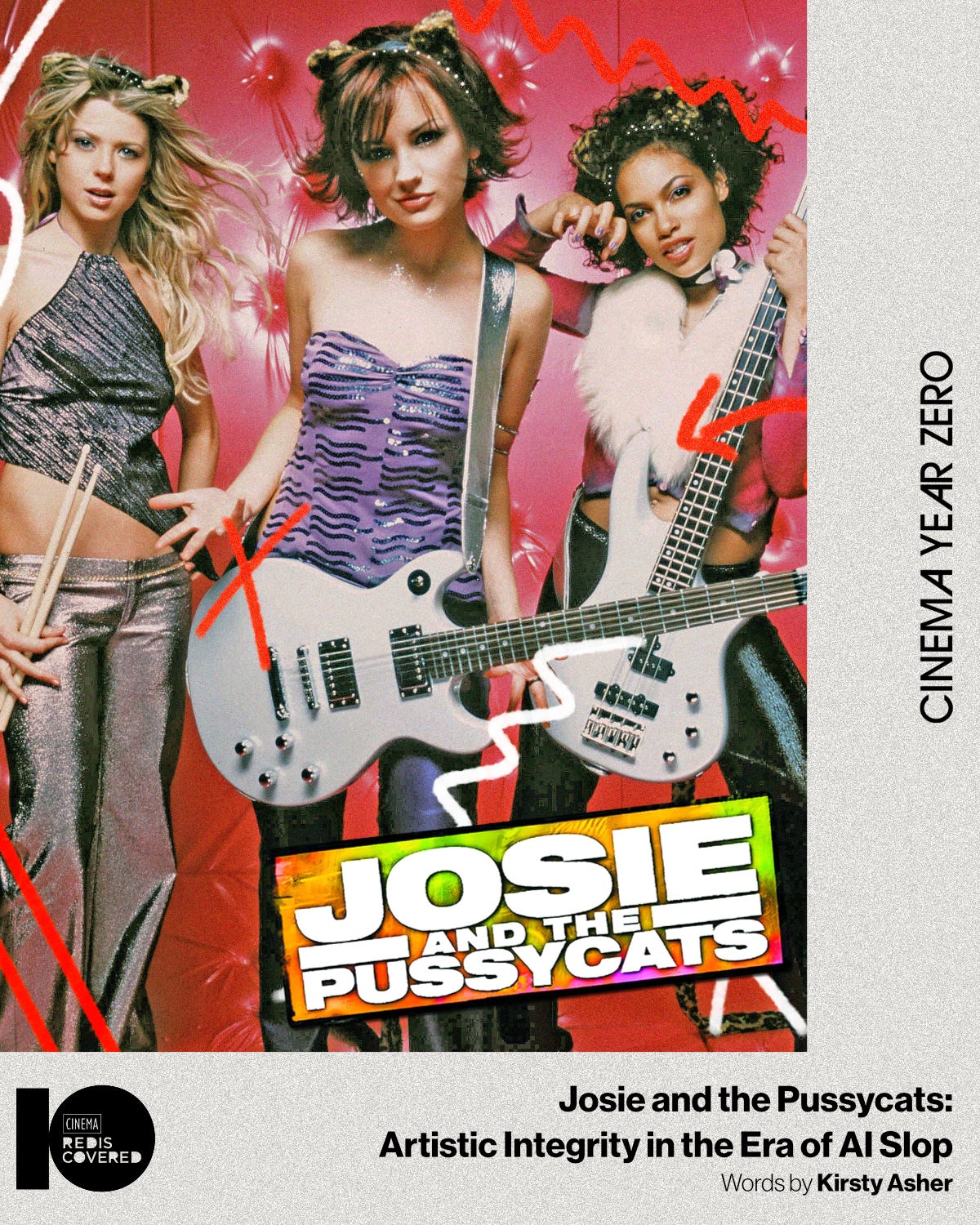
Josie and the Pussycats screens today at 14.00. To celebrate, we present a new essay on the film by Kirsty Asher.
Kirsty Asher is a writer and folklore researcher based in South London. She is Associate Editor of Cinema Year Zero and also writes a folklore blog A Place With Such A Name.
Josie and the Pussycats - Artistic Integrity in the Era of AI Slop
The song of the summer for 2026, according to multiple news outlets and its own internet virality, is Puerto Rico Song. It doesn’t even have an official name. It is credited as being made “by” TikTok user @saxboybilly18 (real name William Stiteler), but Stiteler only wrote the lyrics. The rest of the song—its catchy pentatonic scale, its I-IV-V-VI chord progression and distinctly cosy ‘80s synths—was formulated entirely using generative AI. Now, Stiteler is being approached by the Puerto Rico tourism board about possible promotion collaborations.
The world may not be ready for how AI is already coagulating within the arts, or in what form it will continue to do so. But twenty-five years ago, a devious computer was already turning American teens into super-consumers with subliminal messaging hidden within bubblegum pop-punk in the underappreciated Josie and the Pussycats (2001). While the Puerto Rico Song doesn’t inspire sinister undertones (it mostly blandly lists sightseeing spots), its grip on internet virality and its heralding a new era of popular music is relevant to the film’s conceit—manufactured art warps artistic integrity.
Josie and the Pussycats, an adaptation of the Archie comics and animated TV series, playfully poked at commercialised music with its visual assault of brand signifiers and its melodramatic characterisation of fan culture. It experienced a disjointed reception upon first release from critics who misread the heavily featured branded merchandise, such as Sean P. Means who quipped “I’ve seen NBA games where the advertising was more discreet.” Gradually, retrospective thinkpieces about Josie and the Pussycats being “ahead of its time” are starting to trickle in, in a wider trend of vindication for a generation of women taught to dismiss their adolescent pop-culture treasures as without cultural merit. This speaks to how contemporary popular opinion is shaped by highly selective factors such as cultural perceptions of sexuality, gender, or socioeconomic situations. The reappraisal of The Devil Wears Prada (2006) in a post-financial crisis context, framing Anne Hathaway’s Andy as an ingrate and her boyfriend as the “real villain”, is an example of how cultural priorities shift. What once we scorned, or lionised, can easily be reevaluated with maturity, and with a generational shift in sociopolitical ideals.
The oversaturation of brands in Josie and the Pussycats’ production design was always intentionally crass (and importantly was also not compensated as product placement), but in the early twenty-first century critics saw another tired reminder of a globalised world where mainstream media had become a corporate cavalcade. Still, it speaks to a particularly humourless film critic who couldn’t bear a twitch of the mouth at the kitsch campness of Target bullseye bed pillows and a shower unit featuring tiles and frosted door patterns of the Golden Arches—especially when the intention is a maximalist satire of commercialisation. Indeed, it’s the film’s well-placed paw on the pulse of corporate manufacturing in the creative industries which contributes to its lasting legacy.
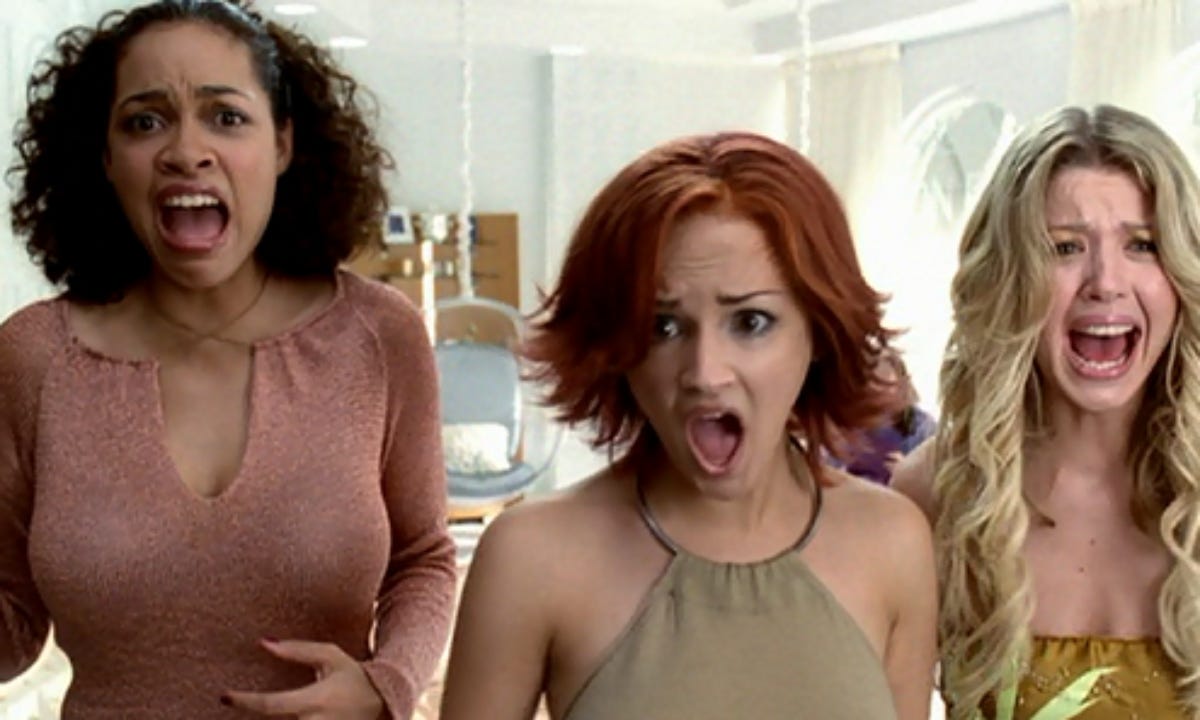
This film was not the first piece of popular media in 2001 to take a dig at institutional or corporate subliminal messaging in pop music. The Simpsons (1989–) episode New Kids on the Blecch, which aired in February that year, gave us the classic “Yvan Eht Nioj” (or ‘Join the Navy’ to the uninitiated) in which Bart and the boys quickly rise to stardom in a manufactured boy band whose purpose is to recruit cannon fodder. Similarly, Josie (Rachel Leigh Cook), Melody (Tara Reid), and Valerie (Rosario Dawson) are plucked from obscurity by MegaRecords to replace recently (and mysteriously) deceased boyband DuJour, and their songs that previously only entertained bowling alley patrons suddenly top the charts. They marvel at their overnight success but do little to question it, instead enjoying a distinctly early ‘00s makeover montage. Little do they know that MegaRecords’ CEO Rachel (Parker Posey) is using a machine called the Megasound 8000 to generate subliminal messages that will keep America’s teens locked into intense hyperconsumerism. Sound familiar? To cap it off, Posey’s character is very much a proto-Musk, pulling the strings behind a deeply unhappy persona whose biggest downfall is a desperation to be cool.
Manufactured musical groups have their origins in dire infamy, as original prefab band The Monkees were unmasked Scooby-style in their attempt to rival The Beatles, a group which had come together in more organic terms. Nevertheless, the concept became more normalised, to the extent that individuals from The X Factor (2004 - 2018) sausage factory still maintain cultural relevance today in their solo work, thanks to the popularity of bands such as Little Mix and One Direction (even if X Factor has now lost its cultural staying power). One could argue that their success was driven by the teams behind these acts whose expertise could perfectly craft a string of hits. But in the age of generative AI, that knowledge is increasingly being left up to the algorithm. Now, the worry is not whether film, music, art, or comedy is replete with adverse subliminal messaging, but whether it was even made by a human at all. The idea of worrying over a manufactured musical group who don’t write their own lyrics pales in comparison.
What a film like Josie and the Pussycats couldn’t predict was what kind of corporations would take a stranglehold over mainstream media, while others fell by the wayside. The companies behind generative AI secure their stranglehold with a phantom grip—they don’t need to slap branding everywhere, so long as their LLMs are being normalised on a widespread scale. And the ‘Puerto Rico Song’ is simply the beginning of a new phase of media consumption, in which the word “manufactured” obfuscates the presumption of human participation beyond a few prompts and clicks.
Even before AI, issues such as the increased ubiquity of CGI and negligible scene lighting have had certain audiences romanticising even the most mid mid-budgets of the 1990s and 2000s. The same could be taken further in terms of gen-AI and Josie and the Pussycats’ pop-punk soundtrack. Sure, it’s slightly corny pop-punk, but several relatively famous humans, including Fountains of Wayne’s Adam Schlesinger and Counting Crow’s Adam Duritz, worked hard to make that cheesy soundtrack, and the record went Gold for it. Human mediocrity becomes powerful by virtue of being human, not the sputterings of machine learning. Played with adept focus by Reid, the dumb-blonde persona of Melody Valentine is far more endearing than a machine that is presumed to be smart.
It has reached a point where cinema is beginning to tentatively confront generative AI in its storytelling approaches, especially in this year’s releases. In the mainstream, The Devil Wears Prada 2 (2026) hired artist Alexis Franklin to painstakingly craft an AI slop meme of Miranda Priestly, with human-made art becoming resistance in and of itself. In the outer perimeters, Radu Jude’s Dracula (2026) turned AI art on itself in suitably ridiculous fashion. Generated images of a prompt for the sex scenes from Francis Ford Coppola’s Bram Stoker’s Dracula (1992) engorge and undulate into rubbery caricatures, monstrous in their constant metamorphosis as the machine hallucinates. I see a direct correlation between the sets festooned with corporate branding in Josie and Jude’s AI humiliation ritual in Dracula—both actively harness the meta-satirical to emphasise their cultural critiques. While Jude lampoons from the fringes, a highly mainstream, family-friendly romp like Josie and the Pussycats took a big leap, and is only now on the verge of delayed appreciation.
Josie and the Pussycats failed hard at the box office, and didn’t charm the critics. But in light of its ahead-of-its-time messaging on the perils of manufactured art, it achieves a charming gutsiness. The integrity at the heart of the story, however simplified for a pre-teen target audience, provides a template for how mainstream art can tackle encroaching threats. Where once it was corporate branding, now gen-AI deserves a glitterpunk send-up. Who will take up the cat-ear mantle?
This article is part of Cinema Rediscovered’s Other Ways of Seeing, a development opportunity supported by BFI awarding funds from National Lottery.