

Looking for Mr. Goodbar
Day III at Cinema Rediscovered


Welcome back to our coverage of Cinema Rediscovered Festival 2026.
Today we present an essay by Daisy Steinhardt on Looking for Mr. Goodbar, which screens on 35mm today at 16.30.
Daisy Steinhardt is a film and media researcher and writer. She is interested in reactionary media, internet politics, and films that make her feel stuff.
Following today’s 11.10 screening of Les Sièges de l’Alcazar, we will chair a casual post-screening discussion of cinephilia at Watershed café/bar.
“I Never Understood What Terrible Thing I Did To Make God So Angry:” Sex and Violence in Looking for Mr. Goodbar (1976)
CW: This piece discusses Looking for Mr. Goodbar in its entirety, and includes major plot points. It contains graphic descriptions of physical and sexual violence.
The 1970s San Francisco in Looking For Mr. Goodbar (1976) embodies tensions between the burgeoning bodily autonomy movement, and the insidious sleaze and violence of the hetero-patriarchal world. As a television broadcasts, it’s gearing up to be the “decade of the dames.” Schoolteacher Theresa Dunn (Diane Keaton) lives in a nuclear family unit with her mother (Priscilla Pointer) and overbearing Catholic father (Richard Kiley), her older sister Katherine (Tuesday Weld) sometimes dropping in with stories of boyfriends and abortions. The film follows a year in Theresa’s life as she makes forays into the world of hook ups and cocaine and 70s funk, picking up and putting down a string of men along the way. The film, directed by Hollywood steady-hand Richard Brooks, is based on Judith Rossner’s 1975 novel of the same name, itself inspired by the 1973 murder of schoolteacher Roseann Quinn. It was relatively difficult to access before 2024 due to soundtrack licensing issues, and is still rarely screened in the UK.
The first man Theresa has sex with is her college professor, Martin Engle (Alan Feinstein). He is older and married; a safe fantasy. What begins as a daydream solidifies into reality as soon as class is over, as he tells her that sex between teacher and student is improper…immoral…illegal…and unbelievably tempting, slowly unzipping her dress. The scene contains the haptic eroticism of forbidden love, with close up shots of Theresa’s face and his hands on her skin. It finishes as quickly as it started. He doesn’t love her, doesn’t want to hurt his wife, doesn’t want to talk to women after he’s fucked them. The subtle subjugation of the mistress bleeds into Theresa’s waking dreams; she imagines Martin hitting her with his car, running through the hospital to find her and proclaiming his undying love. Accepting defeat, she goes home to her father.
Having graduated from college and wanting to escape from her father’s domineering presence, Theresa moves into an apartment in Katherine’s building. Her paternal relationship does somewhat contextualise her attitude towards and expectations of men. But to fall into psychoanalysing Theresa (as Roger Ebert did in a contemporary review) misses the bigger picture that harm within the nuclear family exists as a small-scale articulation of systemic patriarchal violence. This is demonstrated excruciatingly through the slow revelation that Theresa’s misdiagnosis of polio (in place of the congenital scoliosis she inherited from her father) was only acknowledged after it was too late, leaving young Theresa physically immobilised in a full-body cast for a year after surgery.
Theresa begins teaching deaf children and frequenting singles bars, becoming entangled with a man from each world. She meets welfare caseworker James (William Atherton) at the home of one of her pupils. He’s steady, reliable, a good Catholic. Theresa’s family approve. James slowly encroaches on her life. He shows up at her school while she is working; when she rushes to the hospital upon hearing that her father is dying, James is already there.
As her father pulls through, Theresa becomes increasingly unwell. She’s taking more drugs and struggling to look after herself; cockroaches fester in the weeks of unwashed dishes piled in the sink. James’s nice guy veneer starts to crack; he tells her about being twelve years old and witnessing his father violently and sexually assaulting his mother. Theresa holds his face in her hands. They start to have sex for the first time, Theresa barely visible in the frame under his writhing torso. She laughs out loud at the condom he pulls out, in retaliation he tells her that he had made the story about his parents up, laughing in her face as he gets up to leave. As the door shuts behind him, the film cuts to a charcoal drawing on Theresa’s wall of a woman screaming.
James seems worlds away from Tony (Richard Gere), whose eye Theresa catches in a singles bar. Tony is vain and vulgar and a liar, displaying nauseating acts of hypermasculinity at any opportunity. Their sex is darkly lit and unremarkable: enjoyable, but devoid of eroticism. Tony stops halfway through and starts doing press ups. He pretends to threaten her with a knife that turns out to be a glowstick, delighting in her fear, which gradually dulls into disillusionment. The next time he comes round he breaks into her house, takes cocaine with her and force feeds her a Quaalude.
Theresa picks up a succession of old and sleazy men for a quick fuck. One complains that her breasts are too small, another steals her money. A third has his trousers down and his wallet out when Tony angrily bursts into the apartment. He chases the man out of the house, shouting homophobic abuse at him. Theresa slaps him; Tony punches her in the mouth; the woman on the wall screams. Katherine runs downstairs and throws him out. “He was only trying to hurt his mother, we’re all cunts” Theresa cries, holding an ice lolly on her bleeding face. Katherine finds a damp cloth, and cockroaches spill out, scuttling over Theresa’s body.
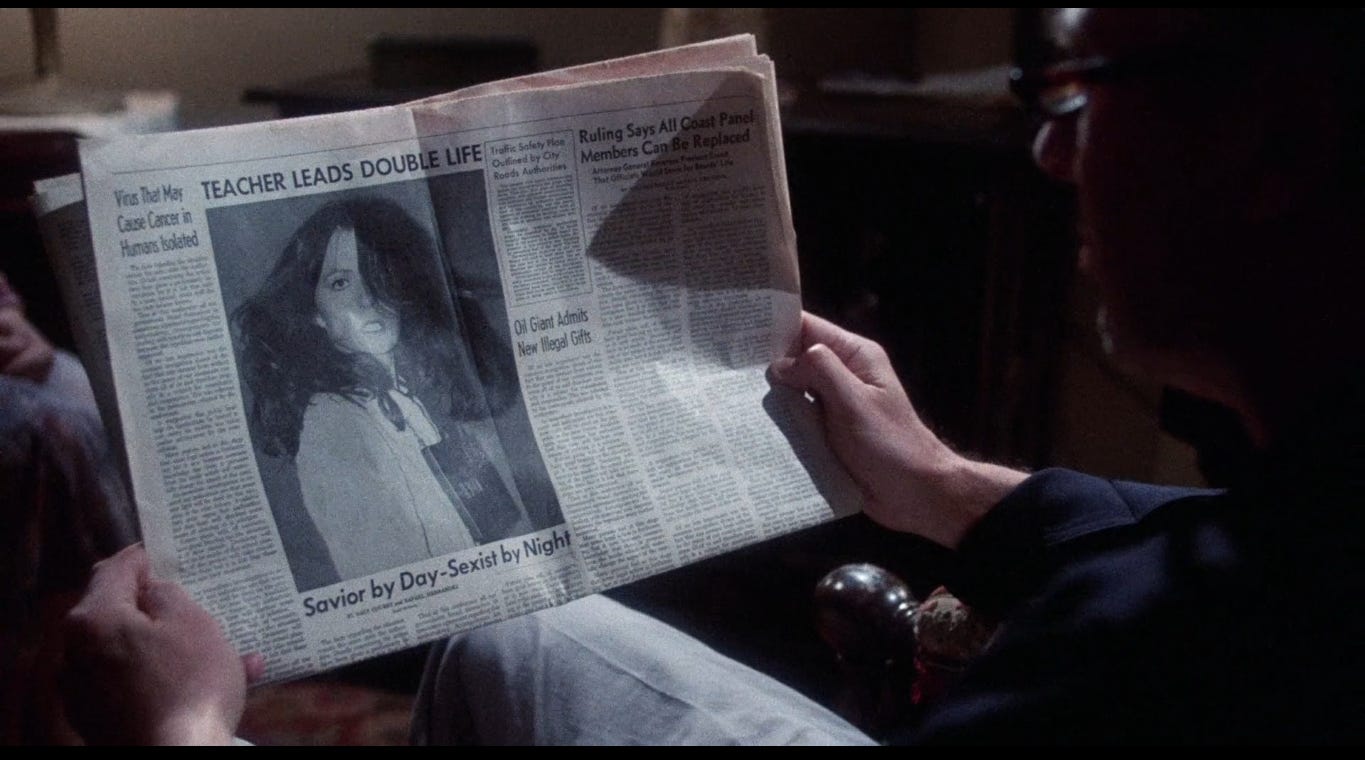
Theresa’s fantasies become more violent. She imagines that Tony has summoned the violent arm of the patriarchal state and she is arrested in a drug raid, her sultry mugshot taking up most of a double page tabloid spread, headlined “Teacher leads double life - saviour by day, sexist by night.” The paper frames the surrounding stories as insignificant: to the left in small print “Virus that may cause cancer in humans isolated,” to the right “Oil Giant admits new illegal gifts.” Her distorted fantasy of getting caught exists in the same media-sphere as the film’s diegetic world; the prurience of the misogynistic tabloid press both glorifies and vilifies the sexual exploits of a woman in charge of protecting children. Theresa’s fear of a salacious media culture resonates today as an early iteration of the countless ‘disgraced teacher has a secret OnlyFans’ headlines that litter tabloid media.
James visits the apartment at Christmas. He’s angry that Theresa is rejecting his gestures of affection, and breaks an erotic wall hanging that she inherited from Katherine. Theresa goes home and her father throws books down the stairs at her. On New Year’s Eve, Tony appears at her door with a single red rose and pretends to ejaculate through the flimsily chained door. Theresa won’t let him in, and picks up her phone, asking the operator for the police. He screams “you are dead” at her before slamming the door and walking off. It’s the last we see of him. She resolves to pack it all in; after the new year she will stop the sex and the drugs.
So when, at a New Year’s party, Theresa picks up a repressed gay man who has just been homophobically attacked, and he rapes and murders her, and she screams for her sister, and takes her last breath while the blue light from the projector flickers out, we as an audience are denied the affective catharsis of her survival into the new year, or the vindication of having correctly identified the bad apple had Tony killed her. Contemporary critics suggested the film punishes her, but in portraying the totality of patriarchal subjugation, femicide is shown to be one ugly endpoint of violent heteromasculine ideals. Theresa tries her best to live a life that she has chosen, but one woman cannot always escape the evil that men do.
This article is part of Cinema Rediscovered’s Other Ways of Seeing, a development opportunity supported by BFI awarding funds from National Lottery.
 | A guest post by
|