

My Brother’s Wedding
Day II at Cinema Rediscovered

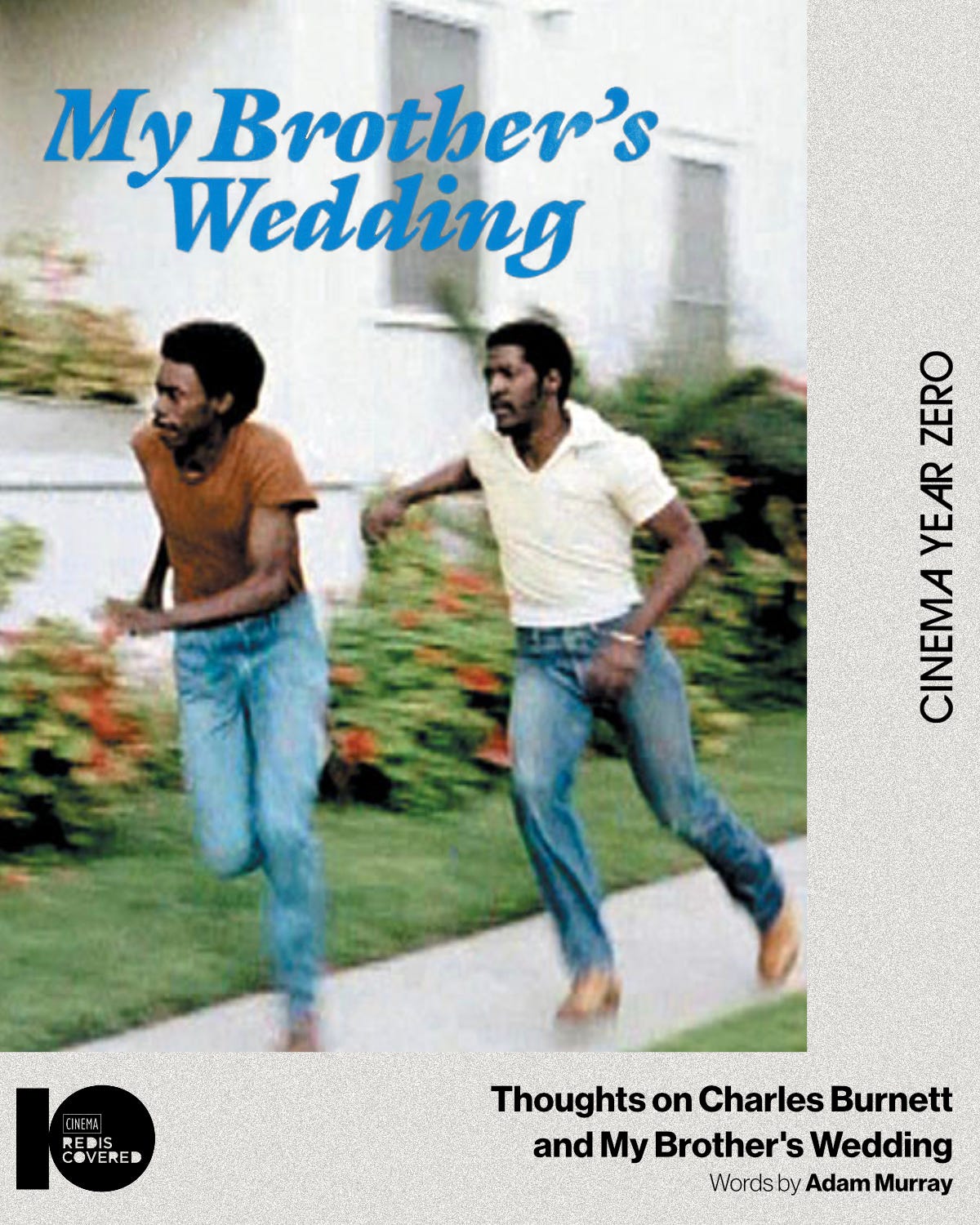
Welcome back to our coverage of Cinema Rediscovered Festival 2026.
Today, we’re happy to present an essay by Adam Murray on My Brother’s Wedding, which screens today at 11.10, and tomorrow at 19.20.
Adam Murray is a Film programmer and Bristol Black Horror Club founder. His interests explore Blackness, Mixed-Race identity, Horror and Hip Hop on screen.
Check back every day this week for a new essay. And if you’re at the festival, you can join us at a couple of free events:
Friday 24th July: we chair Les Sièges de l’Alcazar post-screening discussion of the film’s depiction of the pratfalls of cinephilia at Watershed café/bar.
Saturday 25th July at 15.30, we are hosting a Critics Salon at Pervasive Media Studio, featuring readings and with conversation about our critical practices.
Thoughts on Charles Burnett and My Brother’s Wedding
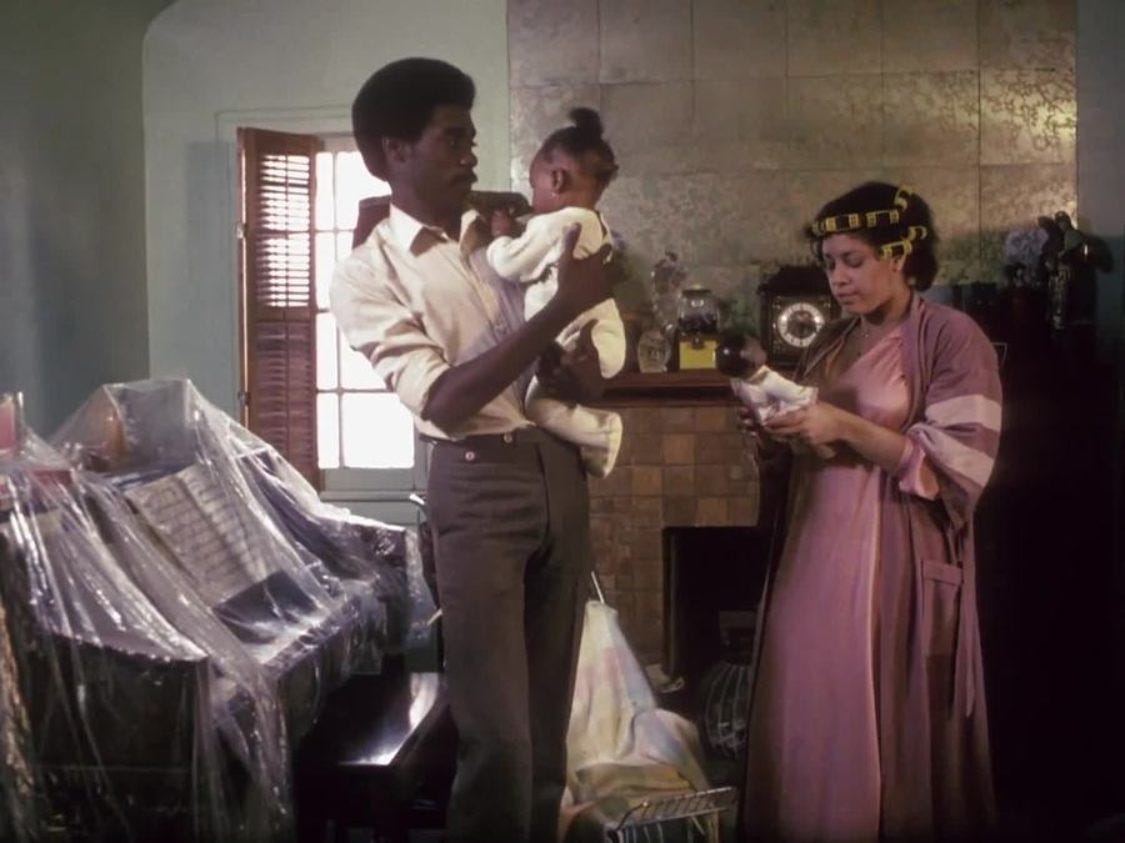
My Brother’s Wedding (1983) raw, honest and at times laugh out loud funny, is a sobering time capsule of early 1980s African American working class life. Contemplative and dreamlike pacing enables the audience to critically unpack what’s unfolding on the screen. It’s a portent of the upheaval and turmoil of the 1990s in Los Angeles’ South Central and Watts neighborhoods: a litmus test for audiences, and a turning point in Charles Burnett’s career.
The story follows Pierce (Everett Silas) a single, young, working class Black man who helps out at his parents dry cleaners, caught in an existential bind between his upwardly mobile older brothers imminent wedding into a middle class family and his allegiance to his best friend Soldier (Ronald Bell) who is soon to be released from prison. At times intentionally ambiguous and observational the film painstakingly depicts daily life from moments of tenderness to harsh brutality, maintaining the same tone of mundanity regardless. Whether it’s play-fighting between Pierce and his father (Denis Kemper) in the dry cleaners, or a breathtaking reunion sequence showing Soldier in his mother’s (Sally Easter) embrace and the hesitant gaze between father (Hobert Durham Jr.) and son, the audience are held in a tense moment of time standing still wondering how his father will react to his sons return from prison.
These seemingly impartial juxtapositions illuminate the systemic quandaries at the heart of young Black working class masculinity. After running the streets all day including an absurdist altercation with a misfired gun and ensuing inconsequential chase, never clearly resolved, Soldier asks Pierce where the rest of their friends are to be met with the solemn revelation from Pierce that they are the only ones left. However detached Burnett might be from prescribing value judgements on his protagonists there is also an authenticity, a grounded understanding and love for the characters and their onscreen daily challenges. This moral distance yet intimate closeness of the portraiture of these characters’ lives as they unfold imbues the film with real poetic power. It is a film that isn’t limited to tragedy. Rich with empathy and glimpses of tenderness and joy, it wrestles with identity, class and the question of ‘becoming’ humanizing Black life/lives onscreen.
Why then, has such a striking work of American cinema been so difficult to see before now? During the editing process the producers, against Burnett’s wishes, submitted an unfinished version to New York Film Festival to meet the deadline. Janet Maslin of The New York Times was scathing in her review of Burnett’s technique as ‘stiff and rudimentary’. The impact on the film and Burnett’s career was devastating. Distributors were turned off by the cold reception. The film was not only shelved, Burnett was not allowed to complete it. It would be eight years before Burnett would revive his career with the success of his black comic masterpiece To Sleep With Anger (1990). My Brother’s Wedding sat on the shelf in obscurity for three decades until Milestone Films purchased the rights allowing a Pacific Film Archive restoration of the print and supporting Burnett to complete a ‘directors cut’ in 2007 to critical acclaim.
Cinema Rediscovered 2024 attendees may recall the UK premiere of The Annihilation of Fish (Burnett, USA, 1999). That film received a similar fate: receiving a negative review at its Toronto International Film Festival premiere, which led to the distributor cancelling its release. Milestone’s meticulous work on the 4K restoration of My Brother’s Wedding is finally righting some wrongs in relation to the film’s reception and legacy. Audiences new to Burnett’s body of work, or who saw a previous iteration, can now experience the film as the director intended.
Filmmakers like Burnett demonstrate to Black people that there are narratives for them free from the restrictions of Hollywood’s preferences for storytelling — how the wider Black diaspora sees itself and not how Hollywood represents it — in front of and behind the camera. As Milestone Films owner and Black Film Archive curator Maya Cade asserts, “If they are a public figure, they are a Black public figure. The idea of who they are in the public imagination is tiny. So what I often do is show people that there is a world for them.” This is the essence of Burnett’s film; a snapshot of Black lives in Black community as they unfold in front of us, liberating possibilities. Similarly, Cade’s archivist project curates new opportunities for Black audiences to re-appraise the works of Black film and Black filmmakers.
Cade draws attention to how the Black director has been failed by the film industry in the USA and beyond. The capitalist commodification of Black artistry and talent as labour has led to Black filmmakers experiencing their lives and careers shaped by a particular “lack of care”. This goes to the heart of Burnett’s experience of the industry. Cade’s activism mitigates the rules of White supremacist commodification, facilitating care and consideration in curation through her role as an archivist while building a platform for income generation and financial stability as distributor.
In My Brother’s Wedding, Burnett achieves a compelling presentation of community replete with dynamic nuances typically denied Black lives, historically and systemically, by the Hollywood studio system. “Whether they made a film in the 1990s or the 1970s, their film never got out into the world. I want to show them that there is a world ready for them.” A world beyond Black communities, a world in which the reproduction of stereotyping is interrogated by all, and especially by those who need most to engage with this deconstruction.
My Brother’s Wedding was conceived in community and frames the struggle that is Burnett’s lived experience as an African American filmmaker, in turn mapping out on shared diasporic Black experience. If Burnett’s films had remained cruelly buried then we would not be here in community and generating a hopeful viewing and dialogue of the film. African storytelling is an oral tradition, an oratorical act; Bob Marley makes a record in Jamaica, but through the diasporic eco-system, the diasporic web, the record, music and message migrate and embed within and across many cultures. Burnett’s protagonist Pierce, a reluctant Griot, delivers oratorical observations that replicate within diasporic communities over time, highlighting differences as well as similarities. Through his oratorical observations of the world around him we are able to experience the turbulence of 1980s Los Angeles and reflect on the similarities and differences of diasporic life and conditions for our own lives and communities today.
We live in a time of ever-encroaching erasure of cultural artifacts and spaces; swathes of the Internet being redacted and firewalled, a reliance on very limited and impermanent streaming catalogues and subscription services, and the creeping all-encompassing anti-art dominance of AI. Restoration, curation, film festivals and repertory cinema sustain a wonderful dynamic of shared community and rediscovery. Partnerships like the one between Milestone, Maya Cade and Festivals like Cinema Rediscovered are ways of keeping film history alive, an act of resistance. Celebrating Burnett’s journey and struggle with this 4K restoration of My Brother’s Wedding is the unique and powerful opportunity we are taking together at this year’s 10th Anniversary of Cinema Rediscovered.
This article is part of Cinema Rediscovered’s Other Ways of Seeing, a development opportunity supported by BFI awarding funds from National Lottery.