

Raindrops Keep Falling on My AK-47
Oliver Hunt on the plastic surfaces of karaoke visuals.

Today, Cinema Year Zero presents a new essay by Oliver Hunt, whose discovery of an obscure 1990s karaoke video leads to a deep dive on the aesthetic pleasures and inherent contradictions of the genre.
Oliver is a programmer and video artist.
John Lennon is dead. His ashes are scattered by long term creative, romantic and sexual partner Yoko Ono in Central Park. Then in 1999, across an entirely different hemisphere, a cameraman aims his lens at a bikini-clad woman who finds herself in a precarious circumstance as a tribal sacrifice unfolds. Tied up, her body will be ritually committed to the Gods. An indeterminable time later, a drunken salaryman sings ‘Let It Be’ in a dulcet tone, contemplating his rebellious youthful aspirations in a karaoke booth off a side alley in Shinjuku. Despite these seemingly opaque moments appearing disconnected, via the lens of karaoke videos still quietly circulating through digital archives, such threads begin to cohere.
Karaoke videos occupy an oddly overlooked corner of video culture. They are, in essence, conceptual grunt work, often found flickering behind the lyrics in the low glow of karaoke booths worldwide. Designed for half glances and minimal engagement, they resemble the faintly Dadaist animations found in bowling alleys. The precedent had been set decades earlier through Max Fleischer’s “bouncing ball” sing-a-long animations of the 1920s, though by the 1980s karaoke companies in Japan had begun folding low-budget video imagery into the format. Throughout the 1990s, karaoke videos circulated primarily via LaserDisc before disappearing into the obscurity of car boot sales and, eventually, online archives.
Karaoke videos are typically delivered in two flavours. The first derives from cheaply purchased stock footage of American skylines or first-person travelogues somehow pressed into service beneath Anglo-Western songs and ultimately mismatched over Morrissey’s warbles. The second, more common for Japanese city pop catalogues, resembles a shoestring rendition of familiar music video grammar: a heartbroken woman clutching candles beneath the moonlight, a youthful Casanova kicking stones down a lonely road, et cetera. Instantly recognisable forms of melodrama. Perhaps lorem ipsum is the key to it all. A placeholder, yes, but also a curious aesthetic proposition. Something recognisable yet unknowable, suggestive of meaning without ever quite delivering it. To the uninitiated, it carries the vague promise of coherence and for the initiated, it is gloriously nonsensical. A plastic surface stretched taut over a void.
The lo-fi karaoke montages of those looping, faintly baffling visuals paired with a hit pop song remain a curiosity in its own right. The imagery (by necessity) must never be too stimulating. Anything genuinely arresting might throw off the aspiring chanteur mid-verse. A visual language of broad genre cues, just enough to establish a vibe for those lingering in the booth but not currently clutching the microphone. Visuals one could distract a child with, perhaps, without much discernment. So what would happen when that fragile contract breaks down? When genre signifiers fall away, and the screen behind the lyrics begins to serve up imagery that is not merely bland, but actively bewildering? Who, one wonders, is responsible for producing such artefacts, and who is diligently archiving them on the Internet Archive for posterity?
In this epoch of relentless video consumption, let’s consider one anomaly that has skirted beneath the radar. Unearthed from the afterglow of the internet’s hum, the karaoke mixtape Everlasting Oldies 1 (2000) now survives online as both an artefact and apparition. Internet Archive user tnsrchv described it lovingly as “a childhood memory”.
DVD Track Listing Contents
01. Morning Has Broken
02. Top of the World
03. Raindrops Keep Falling on My Head
04. The End of the World
05. How Can I Tell Her
06. Rose Rose I Love You
07. Yesterday
08. Sealed with a Kiss
09. Let It Be
10. Your Cheating Heart
11. Help Me Make It through the Night
12. We May Never Love Like This Again
13. Tie a Yellow Ribbon Round the Old Oak Tree
14. Sad Movies
Taken on its own terms, the track listing reads rather like a volume of poetry pulled straight from the psyche of whimpering adolescence. All the more striking, then, that Cat Stevens’ ‘Morning Has Broken’ is entrusted with opening proceedings, only for matters to wind down with Sue Thompson’s ‘Sad Movies’. These song titles feel oddly of a piece, yet to Western audiences born after the arrival of an internet connection, they have largely faded from cultural memory. In Japan, meanwhile, karaoke has quietly preserved once popular music within the contemporary cultural mindset.
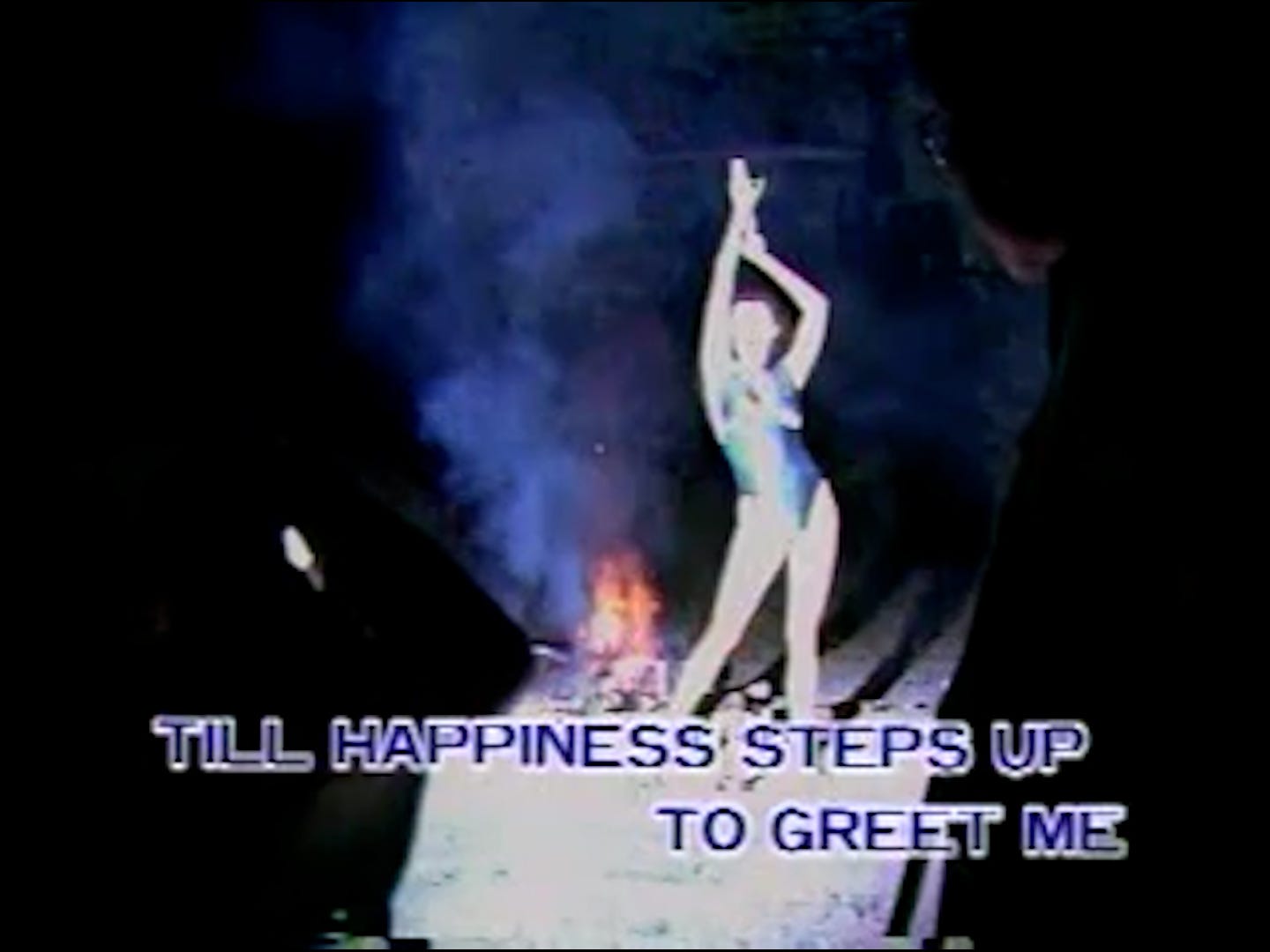
If one were to watch (as I have) the whole collection in one long viewing, it wasn’t until ‘Raindrops Keep Falling on My Head’ began that I perked up with curiosity. Doe-eyed models clad in Union Jack attire pose before vaguely defined “safari protection” figures, rifles in hand, eyes darting uneasily towards the camera. We are presented with a kind of collective daydream, colonial tableaux by way of bargain-bin surrealism. At one point, a small blond haired boy playfully wrestles with a child in traditional tribal dress, the sort of imagery that now instinctively prompts a collective grimace. Bare-chested women look on as Taiwanese models (identified a little later on when draped in their national flag) recline in the brush, posing with children as though assembled for some improbable fashion ethnography. Throughout it all, the karaoke lyrics continue their indifferent forward march. They do not pause for discomfort or rumination. You must keep singing.
Night falls. A fire crackles. Poses are struck. Men with automatic weapons hover just within frame. Whether these men function as protectors or merely as an unstable nod to the perennial idea that guns are “cool” remains open to interpretation. By the time ‘The End of the World’ arrives, a sort of egalitarianism takes hold. The rifles are passed to the models themselves, who handle them with a studied indifference, brushing hair from their eyes as though mildly inconvenienced by the apocalypse. The camera, with quiet insistence, pans down to their pristine white Adidas trainers meeting the dust.
What becomes immediately apparent is that we have departed the safe harbour of reasonable taste and decorum, and drifted instead into the cultural black hole that coalesced at the tail end of the 20th century and dawn of the new. It was a rather unhinged moment in new media. The era in which fringe visual media escaped containment and seeped into the mainstream. Audiences, newly hungry for forms of bodily spectacle that television had previously sanitised, found themselves awash in strange digital subcultures where the likes of Bumfights Vol. 1: A Cause for Concern (2002) circulated with alarming ease via file-sharing forums. The sort of material that took up permanent, rent free residence in the collective psyche of a generation. Taste, in such an environment, became not so much refined as wilfully gauche. For those coming of age in the digital gutter, the future wasn’t bright, it was (quite simply) deranged. Seen through this lens, Everlasting Oldies 1’s colonial safari fantasia feels less like an accident than an inevitable byproduct of its era.
The absurdity finally draws to a close with the comforts of a modern television studio, delivering something resembling a satisfying third act resolution. Two pasty blond hosts sit opposite one of the surviving models in an oddly confrontational yet surreal double act interview, whilst Sue Thompson’s dulcet refrain supplies the emotional scaffolding as she sings “Sad movies always make me cry.” As we dutifully echo the lyrics on screen, the interview dissolves into a montage of the model triumphantly posing with a python. The symbolism is hardly subtle, yet she appears entirely in command. Her fear mastered, a narrative reclaimed. A survivor of this ordeal. “And when he kissed her lips I almost died”.
Interpretive imagery, of course, is almost entirely counterproductive for karaoke. The same could be said for obscure meme montages and bowling alley animations whose very lack of intention makes them oddly fertile ground for postmodern critique. Their absence of artistry, or auteurship, if one is feeling generous, might instead be attributed to a kind of naïve practicality, bordering on the childlike.
Everlasting Oldies 1 emerges, then, as both relic and mirror. A peculiar artefact reflecting globalisation, colonial hangovers, commerce, beauty, and an undercurrent of quiet fatuity. To watch it from beginning to end and impose a narrative is less an act of criticism than one of stylistic endurance. One imagines the members of Ouvroir de littérature potentielle having an absolute field day with material of this sort. We can only imagine what unsettling portraits of 20th Century hang-overs might emerge in Everlasting Oldies 2, 3, or 4. Such artefacts feel strangely primed for reinterpretation in an age oversaturated with images and noise. Sometimes the wisest course is not to look beyond the lyrics, but merely to sing the song you’re given.