

Secret Beyond The Door
NOT BY LYNCH opens tonight.

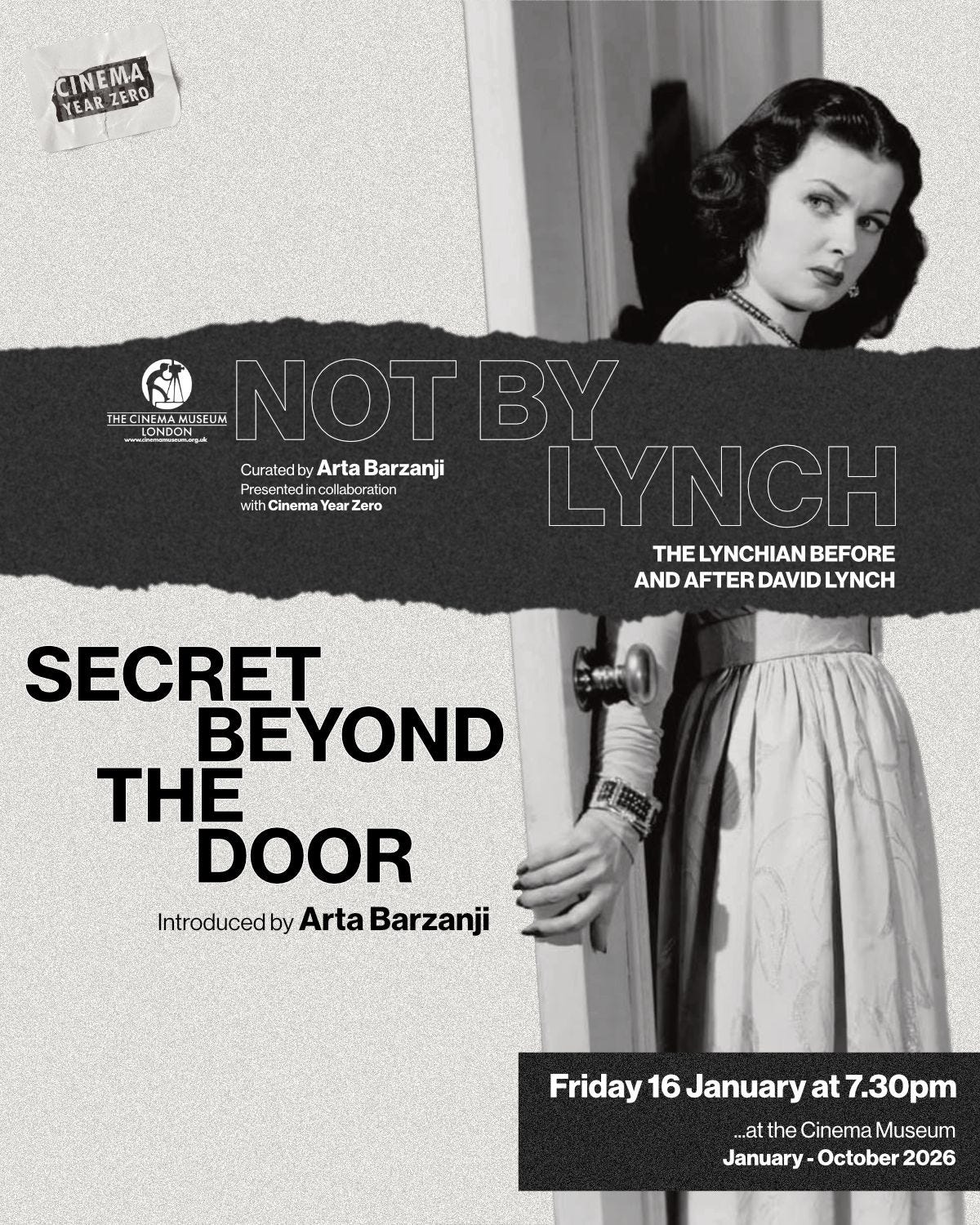
NOT BY LYNCH opens tonight at The Cinema Museum, London. Ahead of the screening, programmer Arta Barzanji introduces his nine-film series, presented in association with Cinema Year Zero. Then, Alonso Aguilar introduces the main feature, Fritz Lang’s Secret Beyond The Door (1947). A few tickets are still available here.
Not Lynch, but Lynchian
Season introduction by Arta Barzanji
When we talk about affinities between films or filmmakers, we often default to the language of influence: who saw what, who inspired whom, which images or ideas travelled from one body of work to another. This way of thinking is useful, but it can also be limiting. The “Lynchian” transcends influence altogether. It has become a widely used adjective, not only within cinephile or critical circles, but also in everyday speech. People speak of spaces, moods, political moments, even personal experiences as feeling “Lynchian”. Very few filmmakers’ names make this leap into common parlance. Hitchcock perhaps did so before, but even that term remains more tethered to cinema style. The Lynchian, by contrast, has entered a broader cultural vocabulary à la Kafka.
This suggests that something more than stylistic singularity is at work. David Lynch was undeniably a unique artist, yet his work gave especially sharp form to a way of perceiving the world that many people already sensed but could not articulate. His films repeatedly stage a tension between surfaces and depths, between the reassuring order of everyday life and what festers beneath it, between the conscious and the unconscious, between reality and something stranger that bleeds through it without warning. The Lynchian names this uneasy coexistence, this sense that the familiar world is structured around profound instability.
It is no accident that this vision emerged so forcefully from within the United States, a society built on extreme contradictions. The promise of democracy, equality, and normalcy sits alongside an ongoing legacy of violence, domination, and repression—both at home and abroad. Lynch’s cinema does not offer a programmatic political critique, yet it uncannily mirrors this structure: a bright façade masking something brutal, uncanny, or monstrous beneath. His films feel truthful not because they explain these contradictions, but because they allow us to experience them.
The films in this season, none of them made by Lynch, trace this sensibility across time. Some precede him, others follow him, but all give form to similar tensions: ordered worlds that fracture, images that betray their own stability, realities that cannot contain what they have repressed. Whether working through noir, experimental cinema, or digital image-making, these films reveal the Lynchian not as a lineage, but as a shared way of encountering a world that is, at its core, profoundly unsettled.
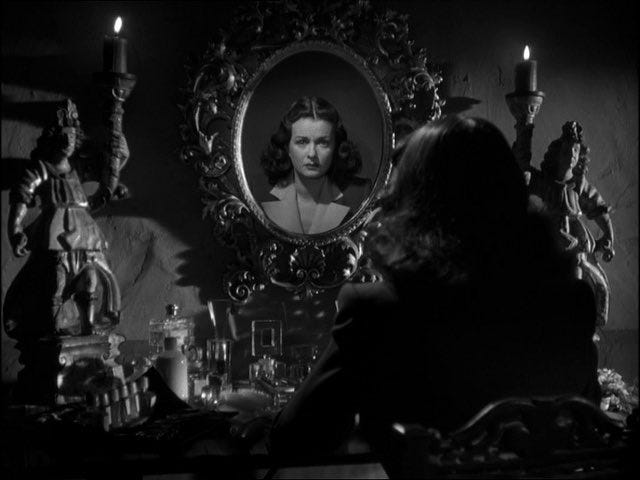
The mysterious world of Secret Beyond the Door
The enduring cult legacy of David Lynch in pop culture can be attributed to the joyfully cryptic and obtuse ways he expressed his disgust with, and outright rejection of, narrative logic. Famously a proponent of approaching films intuitively instead of rationally, the Lynchian ethos could be read as less of an identifiable aesthetic and more a philosophy that guides how one approaches the world around us. This position, however, collides with the spectatorial expectation of finding some sort of hidden meaning behind any assortment of images and sounds. “Not understanding” at face value is interpreted as a need for further inquiry. There has to be a sense of profundity that’s deliberate, no matter how buried beneath the surface. Withholding a sense of resolution is voiding the silent agreement for those who decide to engage with “difficult art”. If there’s no puzzle to be solved, then what’s the point? That sort of structure, however, is antithetical to the liquidity of Lynchian flows, which edge closer to that tenuously called “dream logic”.
In this cinematic dream state, there are glimpses of the unfiltered expressiveness of abstraction; dissonance corroding the soundscapes of daily life, crooked angles evincing unease, characters behaving less like “people” and more like manifestations of concepts, ideas, fears… The genius of that which can be termed Lynchian, however, is never letting hysteria run rampant, only allowing it to take over when catharsis is earned, as all senses fail. Before that, it’s held back by an ongoing tension with the assumed groundedness of figurative “reality”. This diffuse border, this liminal estate of uncanniness and half-truths, is guided by the mercurial twists and turns of affect, eventually leading to a point where the only path forward implies surrendering and being fully consumed by the unknown and the unknowable.
Fritz Lang’s Secret Beyond The Door (1947) has a historical standing as a flawed entry within the German filmmaker’s acclaimed run of bleak and formally stark noirs in 1940s Hollywood. It even shares the same narrative facade on paper: Celia (Joan Bennet), a gorgeous heiress, falls for the cryptic Mark (Michael Redgrave), a man she barely knows, after a rambunctious romance in Mexico, and quickly moves to his New York home, where his true nature hides behind locked doors. The film’s divergent nature is readily apparent from the start, as a haunting cacophony of bells and diffuse water reflections evoke Celia’s wondrous soliloquy about dream interpretation. Unlike the Hitchcockian tradition of psychoanalytical tirades, Lang doesn’t use Freudian iconography for conceptual blunt force or out of narrative motive. His positionality is that of sensuous fascination, embracing the inherent contradictions of this cognitive spiral and letting it wash over the film’s perceptive anchors.
Both audience and characters are unknowingly (and perhaps unwillingly) submerging themselves into a realm of pure delusion. The spiritual influence of Charles Perrault’s eternally ominous Bluebeard fairytale fully comes to the forefront as the film starts mirroring the motifs of folk archetypes and gothic hallucinations. Bennet’s narration quickly loses the existentialist angst of usual noir monologuing, and delves into a pure stream of consciousness, flowing erratically as the film’s rhythm and tone turn more and more delirious. The veil of objective reality is pierced by a violent intrusion of subconsciousness and primal desire, and Lang’s visual grammar acknowledges this by harkening back to the steep angles and stirring shadowplay of his German Expressionist period.
Secret Beyond The Door is pure monochrome phantasmagoria. It embodies the kind of frenzied state of sensory second-guessing and conspicuous hyperreality that could never be fully understood, yet is undoubtedly deeply felt; a dark reverie whose allure lurks stealthily before consuming pervasively.
Alonso Aguilar is a film critic, audiovisual producer and programmer from Costa Rica / Panamá.