

Whistle Down the Wind
Day V at Cinema Rediscovered


One last time: welcome back to Cinema Year Zero at Cinema Rediscovered Festival 2026.
On this holy day, Blaise Radley delivers a sermon on Whistle Down the Wind, which screens on 35mm today at 10.30.
Blaise Radley is a writer based in Brixton, and the features editor at Cinema Year Zero.
Our thanks to the Cinema Rediscovered and Watershed team for inviting this partnership. Cinema Year Zero team members Kirsty Asher and Ben Flanagan are both alumni of Tara Judah’s film criticism workshop at the festival. Much of this publication’s approach to slow criticism is downstream from those experiences, so it has been a privilege to return to Bristol and make this contribution to the festival.
Whistle Down the Wind: Suffer the Little Children
Barely ten minutes pass in the pastoral British coming-of-age classic Whistle Down the Wind (1961) before the three child protagonists find themselves forced into a lie. Adapted from Mary Hayley Bell’s 1958 novel of the same name and set on a struggling smallholding in post-war Lancashire, the film opens with much put upon farm hand Eddie (Norman Bird) attempting to drown a bag of kittens, having been ordered to by the children’s father, the gruff local farmer (Bernard Lee). The children’s motivation in lying is, therefore, altruistic: having saved the kittens they must bluff their way past their father to the safety of the barn. Yet for all their seeming wiles, it’s not long before they themselves are hoodwinked by a complete stranger—and suspected murderer.
This tension is at the heart of Whistle Down the Wind: that children are simultaneously capable of scheming and acts of feckless rebellion, but still vulnerable to adult influence. In the case of Kathy (Hayley Mills), Nan (Diane Holgate), and Charles (Alan Barnes), the moment that triggers their delusion could be the set up for a dad joke. Upon discovering a man, Blakey (Alan Bates), sleeping in their barn (how very Bethlehem) and asking his name, they take his exclamation of “Jesus Christ!” a little too literally, believing him to be the son of God. The various religious zealots in town, from the punctilious Salvation Army soldiers to the hopelessly oblivious Sunday school teacher, really only have themselves to blame.
It’s this Protestant fervour in the Lancashire air that leads to the children being so easily led astray. To the children—and particularly the younger siblings Nan and Charles—Jesus is already a source of superstition, liable to appear at any moment to help with minor problems or correct bad behaviour. Before their fateful encounter with Blakey, Charles talks to a woman from the “Sally Army” who assures him that “He’ll take care of it”—“He” being Jesus and “it” being the repeated attempts to drown the kittens. Moments later, having smuggled the kittens home, Kathy scoffs at the idea that God would intervene and rather cruelly tells Charles that Jesus is dead, attempting to assert her older, more rational view of the world. Her siblings look at her wide-eyed, retorting ominously, “You just wait till Jesus comes and gets you.” A flash of fear crosses Kathy’s face. Batten down the hatches: He is imminent.
Admittedly Blakey doesn’t look much like Jesus. He’s rough and grizzled, wearing an unkempt suit with no tie and a heavy five o’clock shadow across his face. “Jesus wore a long dress,” observes Charles, taking his turn to be sceptical. “Well, that was in them days,” replies Kathy, yesterday’s doubts quelled by Blakey’s sudden appearance. This, if we follow the line of reasoning, is a modern Jesus for a modern age, one who eats table scraps and smokes ciggies. Perhaps that sense of ownership over a Jesus for their generation, alongside the fear and reverence borne of their muddled Christian upbringing, is why they elect to not tell any adults about their holy visitation. If they did, they’d have quickly discovered he was a wanted fugitive on the run—a local scandal the town’s parents misguidedly hide from their kids, speaking only vaguely about stranger danger. White lies a-plenty.
Whatever questions and concerns the children do have around their new messiah are repeatedly bungled by a clergy that is either poorly discerning or actively disinterested. Their Sunday school teacher (Diane Clare) doesn’t question the sudden uptick in questions about what might happen if the second coming occurred now, like right now, or about how one should act when faced with Him. Instead her ignorance only leads to further dramatic irony: “Of course, Jesus has never really left us, has He?” she says, blissfully ignorant in her non-answers. The Vicar, for his part, barely even acknowledges the questions Kathy has about Jesus’ intervention in the world, too focused on petty earthly concerns, like the guttering on the church being nicked, or other minor acts of vandalism.
With traditional religious figures proving ineffective, the Bostock children instead go straight to the source, bringing a posse of local school kids to Blakey for an impromptu sermon—but not before they’ve paid their respects more formally, handing him gifts as if he were still sleeping in a manger. One child passes him a local paper with a charm bracelet concealed inside, another brings him “your book” (the Bible, to you and me), and Kathy, now the most dutiful and thoughtful of the disciples, brings him food to sate his hunger and restore his spirit. That many of these children aren’t actors but rather locals from the surrounding Lancashire villages adds a certain wide-eyed awe.
If the Jesus of the children’s Sunday studies is too stuffy, too serious, too concerned with guttering, Blakey more readily meets the children at their level, however selfishly motivated his actions may be. His congregation gathered, Blakey hesitates briefly, unsure on what spiritual leadership to provide or whether he should even continue his ruse—his lie is, after all, both the most necessary and the most damaging. He leafs through the Bible (it’s unclear whether it sits in his hand awkwardly due to a lack of familiarity or lapsed belief), before putting it to one side and picking up a newspaper, reading the day’s news as if it were scripture. For their part, the children don’t care—it’s less about the substance than the act of communing. Daily news, daily prayers.
Their faith only comes undone when Blakey lets the kitten entrusted to him by Charles die. So earth-shattering is this thoughtlessness that after discovering it Charles tosses the lifeless kitten to the ground, an act both violent beyond his years and indicative of the fragility of childish compassion. In Charles’s eyes, Jesus was explicitly sent here to protect the kittens. To see that Jesus has seemingly ignored his kitten’s suffering breaks Charles’s belief: The problem of evil is something for philosophy text books, not the lives of cats. “It’s dead. He let it die. He let it die. He let it die.” A rather haunting refrain.
Judas may have ultimately betrayed Jesus due to avarice, but he also didn’t believe that Jesus was anything more than a teacher, and certainly not the living embodiment of God. It’s fitting, then, that Charles is the one to betray Blakey—albeit due to a moment of unchecked frustration rather than thirty silver pieces. Cross-cutting between Blakey skulking around the barn and Charles’s birthday party, the children all wearing tall paper hats and eyeballing huge slices of cake, Nan takes an extra portion and slips up, saying in a sing-song tone “One for me and one for Jesus.” Charles retorts, “It isn’t Jesus. It’s just a fella,” and just like that, the gig is up.
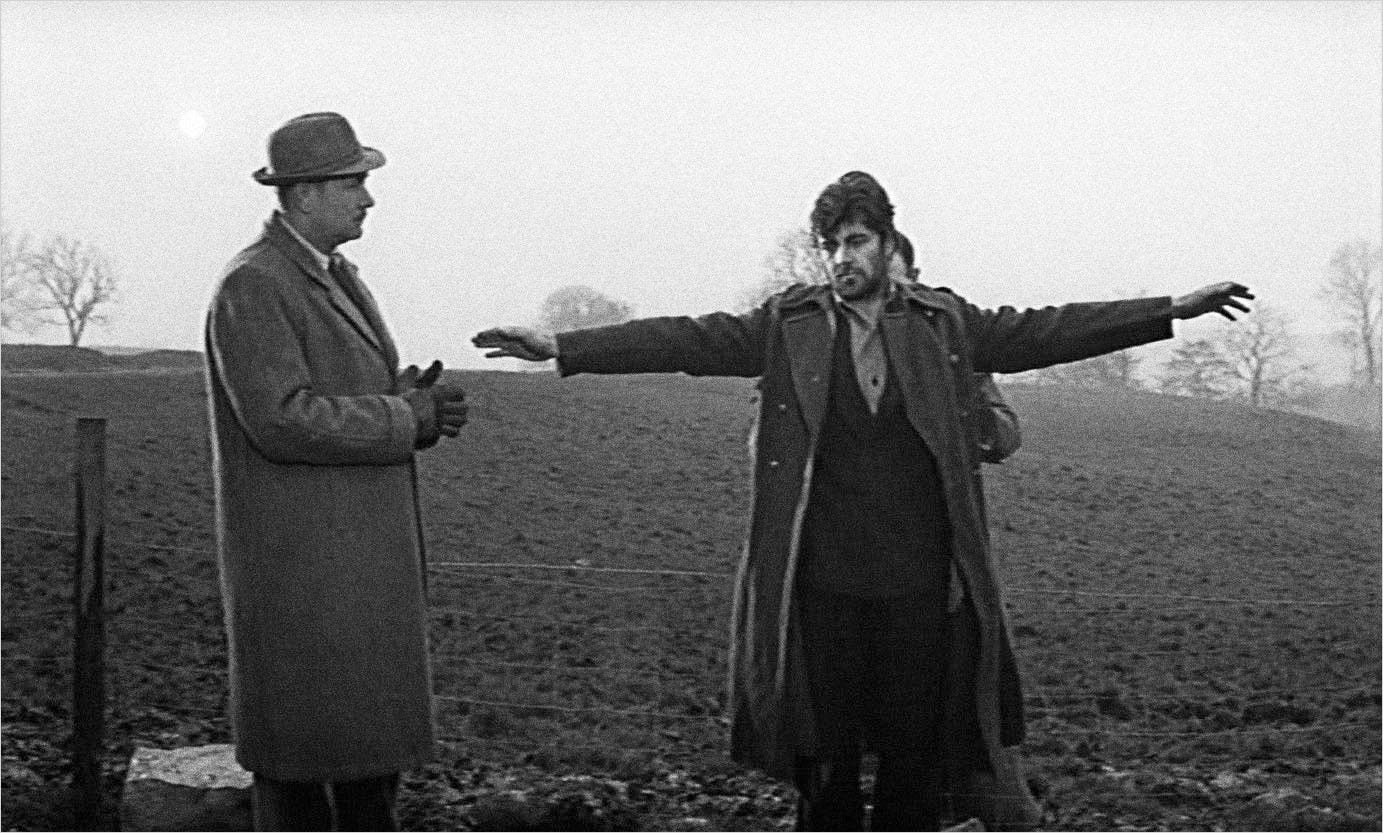
In a film of mostly quaint images, the ones that stick out are those that lean most heavily on religious iconography. One of the film’s last shots is of Blakey being frisked by the police, his arms outstretched so that this silhouette resembles that of the crucifixion. But what is his sacrifice in service of? His final communion with Kathy, taken like confessional through a crack in the barn wall, hinges on an admission of her belief that finally breaks through Blakey’s willingness to profit from her childish naivety. And so, as the police hold their perimeter and hundreds of children descend upon the barn, Blakey sheds a tear and gives himself up. His penance can’t undo the lies, but it does set the children free, enabling them to hold those two contradictory impulses in tension with each other; to remain open to belief while learning to distrust false prophets and adult lies. Isn’t that what growing up is all about?
This article is part of Cinema Rediscovered’s Other Ways of Seeing, a development opportunity supported by BFI awarding funds from National Lottery.