

Danger: Diabolik
Day I at Cinema Rediscovered

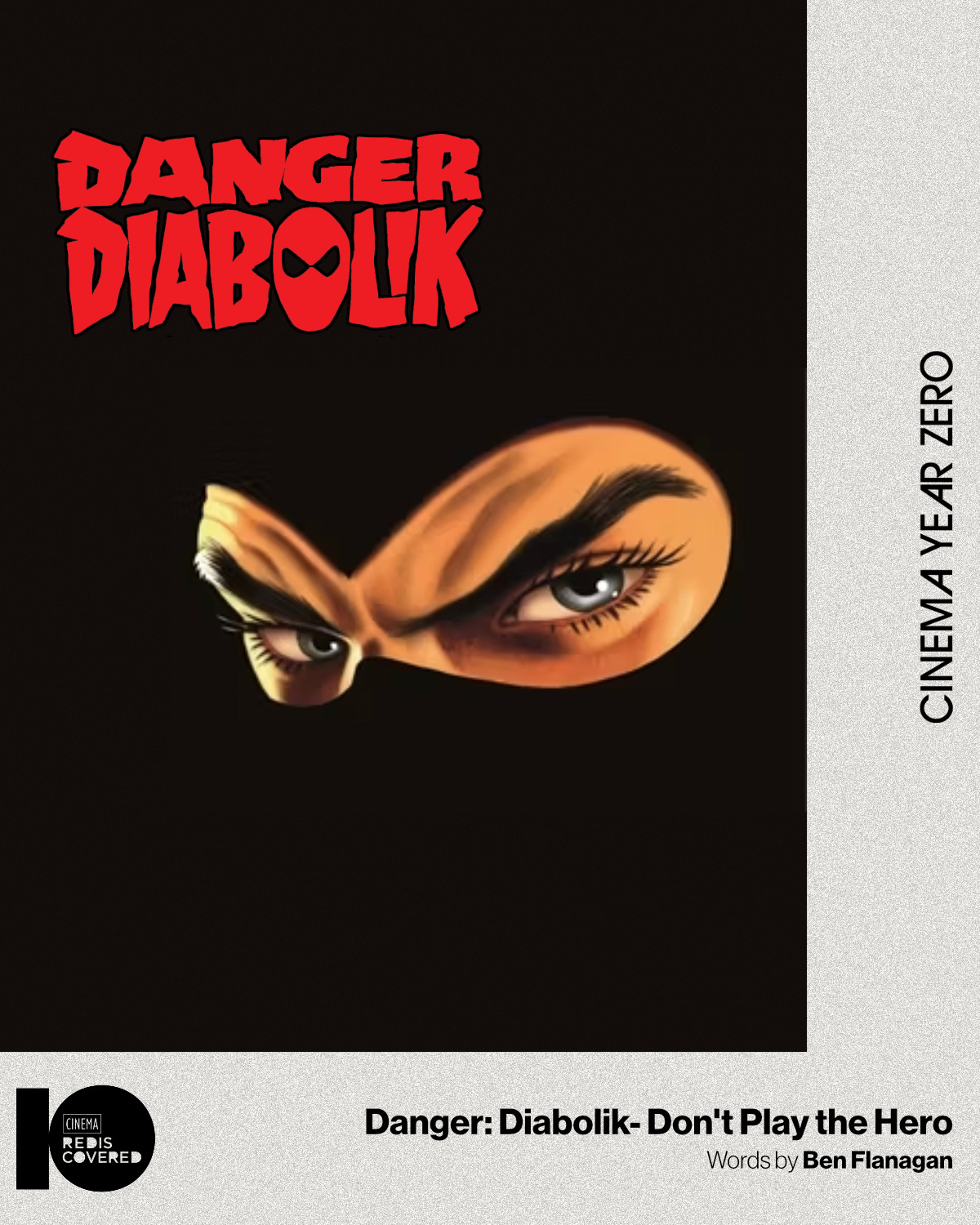
Welcome, friends, to Cinema Year Zero at Cinema Rediscovered 2026. For the festival’s tenth edition, the fine people at Watershed have commissioned our writing on a number of choice films from the festival.
Our coverage begins with an essay by Ben Flanagan on Danger: Diabolik, which opens the festival tonight at 20.30.
Ben Flanagan is a writer based in South London. He is the Managing Editor of Cinema Year Zero.
Check back every day this week for a new essay. And if you’re at the festival, you can join us at a couple of free events:
Friday 24th July: we chair Les Sièges de l’Alcazar post-screening discussion of the film’s depiction of the pratfalls of cinephilia at Watershed café/bar
Danger: Diabolik - Don’t play the hero
A cavalcade of motorbikes cruise towards a bank. Through the revving of engines you can hear the sounds of industry, individualism, the hope of an Italy which looks at fascism in the rear-view. But within plumes of coloured smoke, there he is: the master thief Diabolik (John Phillip Law) who emerges in close-up, and in a flash the loot is gone, along with those illusions.
Who else but Mario Bava could open Danger: Diabolik (1968) so locating the viewer in a richly designed, tactile world, and then letting them sit, with languid blobs of colour occasionally punctuated by graceful camera moves? Having shown a mastery of horror aesthetics in the likes of Black Sabbath (1963), Bava’s budget was pushed to the limit here by producer Dino De Laurentiis—picking up the project which had been abandoned by British director Seth Holt. Shot concurrently with Barbarella (1968), sharing sets and cast members, just as mid-century Italy wrangled its tarnished past with its groovy present, so too are both authority and villainy reevaluated in Danger: Diabolik, where simple romance is navigated through a constant sequence of action set pieces.
The Diabolik comic book which Danger: Diabolik is based on is itself a reinterpolation of French Detective Fiction character Fantômas, which enjoyed its own successful 1960s film trilogy. In what became known as fumetti neri (black comics), other comics including Kriminal and Satanik would riff on the character. Given their salacious lashings of sex and violence, abounding moral panic led to some publishers being put on trial in the mid-1960s. So by the time of Danger: Diabolik, the genre had been somewhat defanged. As such, Danger: Diabolik brims with visual double entendre. This might recall the Bond-crazed, Euro Spy Film cycle, but be warned: there are no heroes within, just a beguiling supervillain.
As is made clear after the initial bank job, Diabolik is no Robin Hood; he’d rather use those piles of cash as bedding on which to make love to Eva Kant (Giallo legend Marisa Mell), than hand any of it out to the poor. The film constantly ironises sexual politics. At the time when Bond was at his most bum-smackingly revolting, Diabolik’s relationship with co-conspirator Eva is surprisingly tender. Connery would never have broken into a castle to steal Moneypenny some jewels. But Diabolik is ready to risk it all for Eva’s approval.
Bava has a curious place in film history. So venerated and influential in genre circles: Blood and Black Lace (1964) setting the template for Giallo, Black Sunday (1960) throwing the gauntlet for Gothic horror. Yet auteurist critics lambast his seemingly absent personal point of view. His films are beautiful sundaes, empty calories. The film critic Serge Daney criticised Bava’s “desire for authenticity at all costs, efforts to make us forget the artifice of the endeavour. Tiny details succeed, but cannot make up for a non-existent whole.” This emptiness gets at something deeper. His films are rooted in ‘camp’ B-movie aesthetics, but there is a psychic alienation and paranoia that pulls us into modernity. I believe time has been kind to Bava, that these tiny details are the very stuff that makes Cinema so compelling: they are a portal to an alternate history of the world.
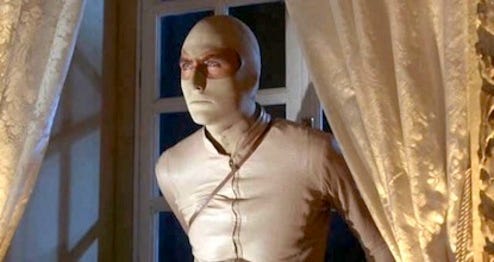
Consider the sequence of images that introduces Eva, sensually moving the pair together, with a revolving background that brings us into their opulent lair for the first time. It is vast and geometric, like a space from Lang’s silent epics. The constant twang of Ennio Morricone’s sui generis soundtrack, which combines the typical operatic wailing of ‘Ecstacy of Gold’ with jazz noodling and surf guitars, echoes around polygonous production design—memorably, in cinema’s second most famous shower, which cheekily covers Eva and Diabolik’s nether regions. Law’s Diabolik is a flat presence, necessarily Yankee in his smug upending of European hierarchy. He is mere set dressing, which Bava points out with regularity. For a jewel heist (it’s Eva’s birthday after all), Diabolik doesn’t just don a balaclava: the mask goes up his nostrils and around his lips to perfectly illustrate a second, blank face.
Bava chops up the elements of his images, from cast to set dressing, into harmonious quadrangular compositions, recreating the effect of reading a comic book without lapsing into literalism (as the groovy 1966 Batman had). A zoom out from Eva’s eyes reveal them to be framed in a rear view mirror, and through the windshield: a gothic castle. Other superimpositions of faces onto day for night photography look surreal and uncanny, adding to the film’s zeitgeisty pop art fascination. This visual affect becomes a part of the plot too, such as when Diabolik and Eva escape a police tail using a complex web of decoys and mirrors to throw them off the scent.
Don’t sympathise with the cops too much. Their only purpose is to harsh our mellow: nimbly illustrated in a discotheque where some frivolous smoking of the devil’s lettuce is interrupted by a police raid. That scene has inspired queer readings of the film: How suggestive are the joints that men pass from mouth to mouth? The film’s thrum of bisexuality goes further, with Terry-Thomas treading the line: is he playing gay, or just posh? As the increasingly authoritarian Minister of the Interior, Terry-Thomas’s one-of-a-kind stiff upper lip creates an abject psychedelia.
For Inspector Zinko, the Wile E. Coyote to Diabolik’s Roadrunner, there could be no better choice than Michel Piccoli. That talismanic character actor brought a vulnerability to the stock authority figure role across French cinema. He gives up the moral grandstanding almost immediately here, by going into business with wretched mafioso Valmont (Adolfo Celi, fresh from the shark tank in Thunderball (1965) as Emilio Largo), neatly depicting corrupt law enforcement‘s relationship to organised crime in mid-century Italy.
Even the nameless country in which the film is set is a mish-mash of European signifiers. Many of Bava’s films are bound to a few locations—he is the master of the haunted house after all. But Danger: Diabolik is a broad epic, which sweeps across locations in a web of national landscapes. From the dockyard opening, to the gothic castle, to motorways, and eventually to the sea depths. Between Piccoli, Celi, and Terry-Thomas, we have France, Italy, and England representing different poles of interest in this case. Diabolik, thus, is the flash American, who swoops the Austrian Eva. These rampant individualists charge across an ever-evolving game board, only stopping when the film seems to run out of steam. What irony after Valmont brandishes a gun with a wicked glint, Zinko yells “Don’t play the hero!” As though anyone was under such illusions.
Danger: Diabolik is a sheer procession of excessively stylised images. It matches the chaos of Dino De Laurentiis’ production style, setting a precedent for the formal qualities which are shared by comic books and the cinema. Bava’s film lingers through pop culture: The Beastie Boys ‘Body Movin’ video (1998) freely riffs on the film, while a new, “slopified” Italian reboot trilogy (2021-2023) sees Diabolik facing off with Ginko through hours of digital sheen. It’s a curious fact that this film was chosen for the final episode of the sardonic roast-a-movie series Mystery Science Theatre 3000 (1999). Its chintzy, joyously silly tone shouldn’t be mistaken as a failing. It speaks well to contemporary cinephile culture that this film is now taken seriously enough to open a film festival. Less Rediscovered than reclaimed. But watch out for your jewels when the lights go down, because Diabolik gets everywhere.
This article is part of Cinema Rediscovered’s Other Ways of Seeing, a development opportunity supported by BFI awarding funds from National Lottery.