


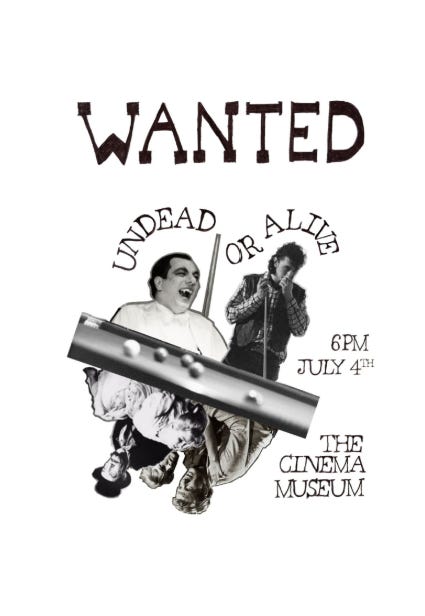
This past weekend, Cinema Year Zero provided programme notes for a double bill screening of two cowboy vs vampire films. Presented at The Cinema Museum by programmers Kit Ramsay and Jack Higgins, Wanted: Undead or Alive paired Billy the Kid Vs Dracula (1966) with Billy the Kid and the Green Baize Vampire (1986), the latter playing on a pristine 35mm print.
Below, you can read Ben Flanagan’s piece on Billy the Kid Vs Dracula. Check out Blaise Radley on Billy the Kid and the Green Baize Vampire here.
Billy the Kid vs Dracula (1966, William Beaudine)
It takes patience to love the films of William Beaudine. Posthumously nicknamed ‘one-shot’ for his apocryphal tendency not to retake, he worked across genres, from beginnings in socially-alert silents through to the comic and criminal demands of poverty row. He handled large, unruly ensembles, composed of faces you just don’t see on screen anymore—and maybe never should have. His hastily-produced films often ran no longer than 75 minutes, captured in long, static shots, and without emphasis on such aesthetic gluttony as blocking or camera placement. Scenes drag for as long as they can, to hit the requisite length and get everyone paid. This economical production line would make Roger Corman look like a decadent emperor. By the time of his death in 1970, he amassed an estimated 200 features, painting a filmmaking persona which has drifted into myth. How apt for a filmmaker who toyed with the imagery of cultural folklore. Just take his final film, Billy the Kid vs Dracula, which has become perhaps the most representative of this unique figure in the American Cinema.
Beaudine’s slipshod, clumsily-arranged films hold together on the flimsiest of pretexts. Billy the Kid vs Dracula is no different. After a spooky, bat-on-a-string set of opening credits, it imagines the historical outlaw William “Billy The Kid” Bonney (Chuck Courtney) settling down to marry the virginal Betty (Melinda Casey). But as luck would have it, her new-in-town uncle, James Underhill (John Carradine), is harbouring a bloody secret. As fang-tastical murders occur around them, Billy ponders picking up his old gunslinging ways to rid the townsfolk of the demonic presence.
You see, it’s really like Hamlet. Beaudine’s fantasmagoria blends together various mid-century pop-cultural touchstones. It’s the kind of tale you might imagine a turn-of-the-century gang of children playing in the street, with twigs for guns and a blanket for a cape. This simple imagination has earned the film an unjust reputation on bad film lists. If you can reach its wavelength, then in the duration of shots, as you watch time pass through its performers, Beaudine’s film will begin to recall Straub–Huillet or Pedro Costa. Like them, he depicts iconography buried deep in our collective subconscious: Frankenstein, Lassie, even The Devil himself.
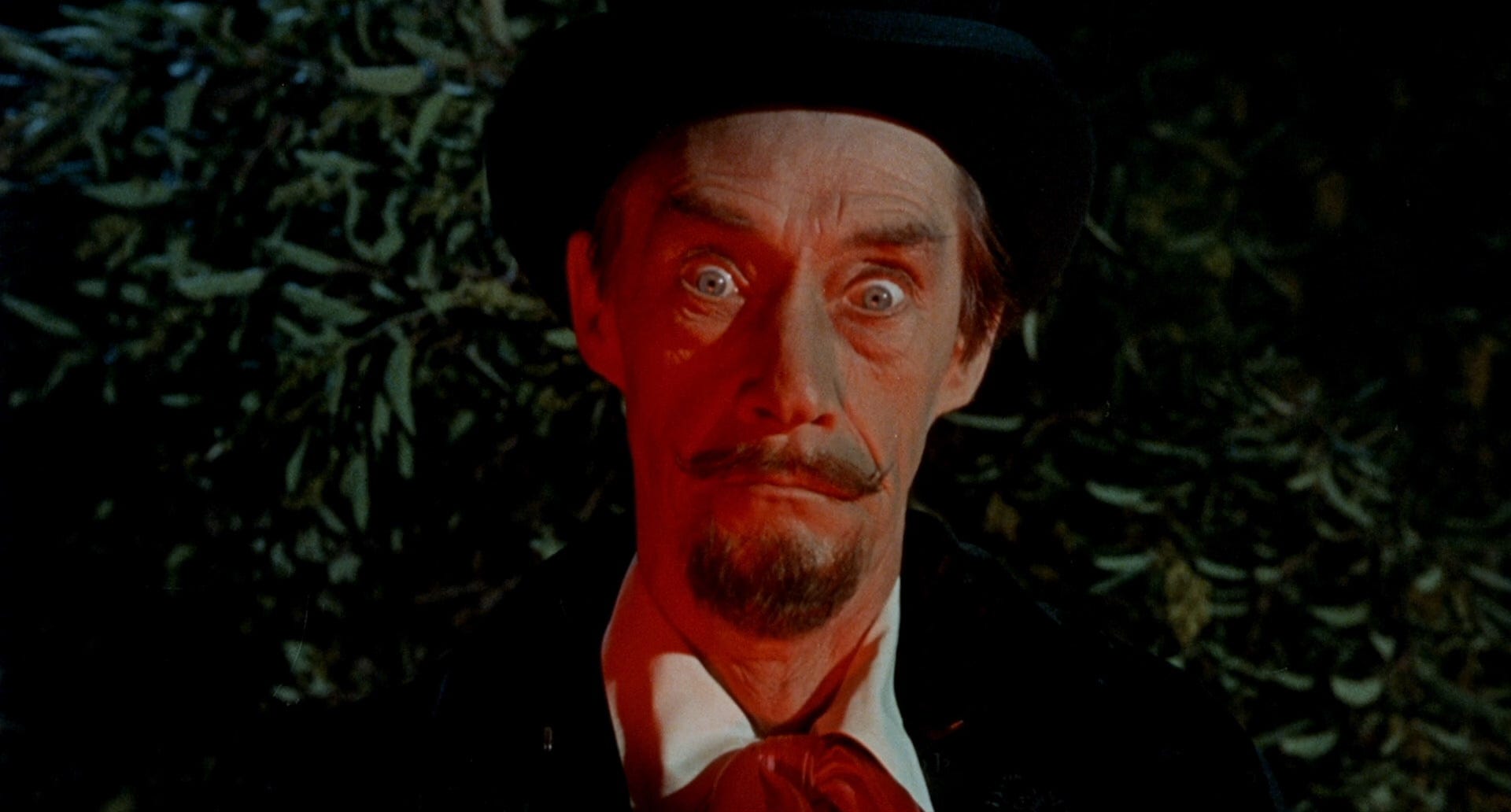
Underhill himself is never explicitly named as Dracula, the casting does that work for us. Carradine, patriarch of the family whose next generation of workhorses would go on to act for Tarantino, Altman, and in Revenge of the Nerds (1984), is inseparable from the Beaudine legend. Having survived a career of imperious respectability in films for De Mille and Ford, by 1966 he was slumming it in the B-movie mines, relying on a face that seemed carved out of stone to play Dracula again and again. His Count is all rizz, carcinogenic voice and scarlet bowtie doing the heavy lifting for a character who spends most of the run time creeping on his niece.
For his part, Courtney had been a journeyman across TV westerns, notably as The Lone Ranger’s nephew (1950–1955), and he brings a slightly jaded air to his Billy the Kid. Courtney would meet a tragic Hollywood ending in 2000, which adds another grim arpeggio to a contemporary viewing.
The text’s themes of suspicion and doubt tie back to folkloric superstition and legends that Beaudine traffics in. The viewer brings a shared cultural history, to which Beaudine adds dramatic shadows, the wind blowing through the trees, a heroine tearfully regaining composure. The stuff of cinematic poetry is all here. With a little patience, the films of William Beaudine offer an access point to the characters, histories, and dreams that made up Old Hollywood.