


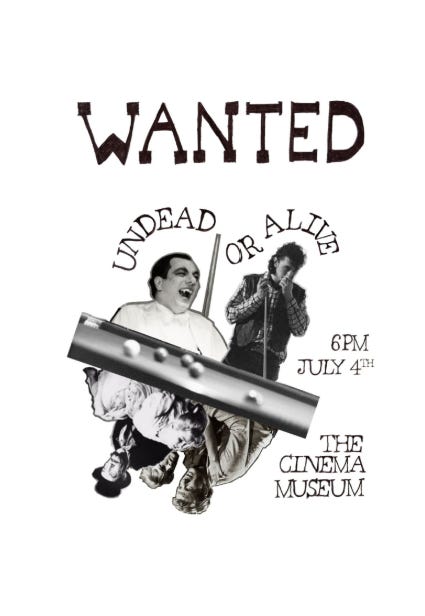
This past weekend, Cinema Year Zero provided programme notes for a double bill screening of two cowboy vs vampire films. Presented at The Cinema Museum by programmers Kit Ramsay and Jack Higgins, Wanted: Undead or Alive paired Billy the Kid Vs Dracula (1966) with Billy the Kid and the Green Baize Vampire (1986), the latter playing on a pristine 35mm print.
Below, it’s Blaise on Baize: Blaise Radley tackles Billy the Kid and the Green Baize Vampire. We published Ben Flanagan on Billy the Kid Vs Dracula here.
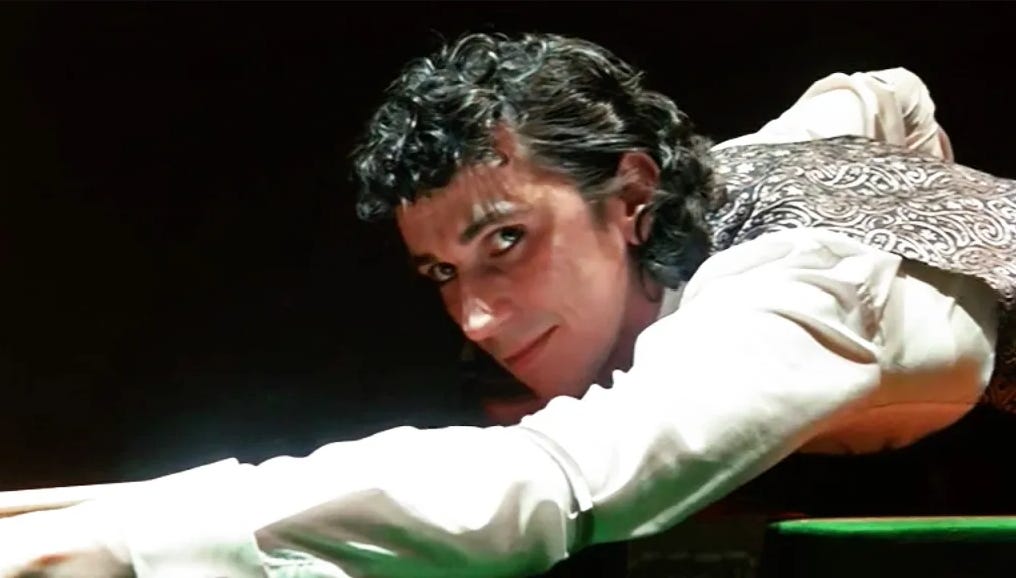
Billy the Kid and the Green Baize Vampire (1985, Alan Clarke)
Britain might not be able to lay claim to many aesthetic sensibilities, but camp is certainly one of them (not to be confused with its boisterous US equivalent, schlock). You can find it in Ealing Studios, Hammer Horror, and Doctor Who serials; in the Carry On films and Rocky Horror (1975). Yet, in recent years it’s been pushed to the cultural peripheries, limited to drag shows, local pantomime, and, occasionally, Inside No. 9 (2014-2024). Indeed, it’s hard to imagine a modern British auteur, except perhaps Peter Strickland, risking their reputation on a style so out of fashion—let alone on something as offbeat and tasteless as Alan Clarke’s wonderful snooker vampire rock opera, Billy the Kid and the Green Baize Vampire (1985).
The core tenet of camp is reimagining reality as something louder, brasher, queerer, disrupting traditional artistic signifiers in the process. And so it is with Billy the Kid, which turns the real-life snooker rivalry between Ray Reardon (nicknamed Dracula due to his dodgy hairline and prominent canines) and then-upstart Jimmy White into the basis for a grungy musical—as was the done thing in the mid ‘80s. For a film with so many genre qualifiers, the narrative itself is markedly simple, hinging entirely on a grudge match between the pair, reimagined as the Green Baize Vampire, played by Alun Armstrong, and Billy the Kid (no relation), played by Phil Daniels.
If his name wasn’t a giveaway, the Green Baize Vampire’s introduction is pure camp, leaning on cinema’s most recognisably Draculean imagery: moody gothic architecture, an ornate coffin on a large stone plinth, and an imposing pale-faced figure with a jet-black widow’s peak. But vampires don’t usually look so knowingly at the camera, nor do they typically apply a post-slumber squirt of breath spray as a sparkle of light makes a *ding* on one of their elongated fangs. The comedic reveal that this is, in fact, an advertising shoot only adds to the theatricality. There’s nothing so camp as a deflating rug pull.
Elsewhere, Clarke flirts with poor taste right from the first number, in which Billy the Kid performs an ode to money or “green stamps”, sharing his cash winnings with the other denizens of the half-lit underworld he occupies, and singing about the “stink of sour piss”. Then there’s the vamp’s gauche abode, replete with plump red furniture, a painted portrait with light-up eyes, and black and white marble walls—rendered all the sillier for clearly being a cheaply done-up two-up, two-down as opposed to an imposing castle. If nothing else, this might be the only musical in which someone sings “GBH or GDP?”
At the surface, Clarke seems an unlikely candidate for such campery. There’s little stylistic precedent for Billy the Kid in Clarke’s filmography, a body of work made up largely of confrontational social realist dramas filmed for the BBC. Stars of the Roller State Disco (1984) comes closest, set in an exaggerated Thatcherite Britain where the local job centre is a live-in panopticon around which young people skate in a listless loop. But it’s still hard-nosed, gritty, violent. There are no musical numbers set in the cloisters of an ornate snooker hall. And yet even in the aesthetic realm of the artificial and self-aware, Clarke’s proclivities emerge—this is, ultimately, a film of the haves and the have-nots, where a young man of the people stands up against ageing draconian institutions.
If camp is intended as a disruption of the status quo, perhaps Clarke was drawn to this material by the opportunity to break with the inequalities of Thatcherism rather than grimly comment on them. The artifice of camp enables Clarke to construct a reality where the local café functions as a refuge for the poor and disaffected, where the crooked con men are overturned, and where Jimmy White (often considered the best player to never win the World Championship) finally won his world title. Who knows—maybe heaven’s covered in green baize after all.