Cinema Year Zero's 2025 poll
Substack's biggest night.

Welcome to 2026. Let’s take a moment to remember 2025.
This was a big year for Cinema Year Zero. We moved over to Substack, which for all its faults has opened us up to a new readership and given us increased flexibility.
We branched out into reviews of contemporary films with our Cinema Year ‘25 supplement.
We launched our Ken Russell issue in July with a sold out event at The Cinema Museum.
We produced the print programme for The Creative Nonfiction Film Weekend.
We announced a screening series, NOT BY LYNCH. It kicks off next Friday with Fritz Lang’s The Secret Behind the Door (1947).
Thanks to everyone who has read and followed us this year, popped by one of our events, picked up a print copy, supported us as a subscriber, or otherwise contributed as we continue to grow as a publication.
Now, the main event.
Cinema Year Zero polled 50 contributors, colleagues, and idols, on their favourite films of the year. Below, you’ll find the top ten. You can read the individual ballots and discoveries lists here.
At a time when the online far-right are obsessed with verbalising childish fantasies of their ideology, Igor Bezinović’s docudrama/heritage project Fiume o Morte! acts as a timely reminder of how the beginnings of fascism boil down to playing dress-up and putting on a show. The Croatian director’s home city of Rijeka, known in Italian as Fiume, was the one-time kingdom of Italian poet and proto-fascist Gabriele D’Annunzio. Between 1919 and 1920 he occupied the city, declaring it the Italian Regency of Carnaro before eventually being ousted by the Italian state. The city’s population has varying opinions of D’Annunzio, from historical ignorance or fierce hatred (by the local Croats), to embarrassed acknowledgement or centrist descriptives of his poetic capability (by the Italian minority).
It feels pertinent, then, that this project of recreating the occupation through the plethora of archive footage and images was undertaken with the general population of Rijeka, many of whom have never performed or been on camera before. Bezinović enlists a range of suitably bald men to play D’Annunzio through different stages of the historic event and, among others, a band of local young men to play D’Annunzio’s eager fascist youth. Thinning the veil between the past and the present with such a close reenactment of archival material enables the reenactors, and the audience, to understand how perilously enjoyable the descent into fascism can be. That is, of course, before it all ends in blood and tears. Kirsty Asher
Resurrection (Bi Gan, China)
Few auteurs have emerged into the mainstream in the last ten years, but the release of Bi Gan’s Resurrection proves that his films have become major events. Its ascent to the Chinese box office summit, where it debuted at number 1, signals a potential for The New Cinephilia in our Chinese century. Did it all make sense? Not really, though its paean to cinema history is a captivating wormhole. Is it visually stunning? Yes, if you like the odd digital sterility that will remind you of Terry Gilliam.
I confess to having struggled with Resurrection during my first watch. Constantly reinventing itself, the plot is challenging at best. Yet, it swirls around the memory like film’s history, a flicker book of images, a Babylon (2022) montage, a Jay Kelly (2025) montage. The centrepiece New Year’s Eve section—three for three on Bi films culminating in a bravura tracking shot—is stunning even for those jaded by decades of rip-off Jancsó oners. It melts away with a final image that will make cinephiles, and people who are invested in cinema as a physical space to dream, tearful. Which other contemporary filmmakers so desperately attempt to prove that movies are still alive? Ben Flanagan
A fake documentary about a real liar who went not-missing and tried to make a film about it, Debut, or Objects of the Field of Debris as Currently Catalogued spills audience members into a hauntological Borgesian wormhole-vat. Its opening shivers its way through a slideshow of stark crime scene images. They are objects belonging to the missing Julian Castronovo (director) and they set up its central oxymoron: dispassionate curiosity. The voiceover made me feel like a typist receiving dispatches on a tape recorder, carrying the clinical indifference of a shipping forecast. But the film marries this tempering tone with the fascinating kind of trembling, digi-fungal images normally reserved for Silent Hill games and creepypastas. Inevitably, one is drawn into this mystery, getting the sense that Castronovo’s brain was fizzing with so many ideas that this is a great purge, a splattering of Stuff hemmed into a transom of frosty inventory and inquisitive policier bleakness. Tom de Lancy Green
What do you see when you look at your nation’s flag? Tradition? Honour? Hope? We get some idea of what the Catalan director Albert Serra sees in la Rojigualda, in this bloody and immersive mandala of the bullfighting ring. Across the a dozen or so corridas which constitute Afternoons of Solitude, Peruvian bullfighter Andrés Roca Rey performs his ritual with pride and exquisite precision, and oft-referenced continent-sized balls.
For the educated cinephile class, it will be impossible not to read fascism, toxic masculinity, and the rest into the film. For others, this could become a new nationalist classic. But Serra’s lack of commentary is telling. Like Frederick Wiseman, a zoom in on a gorged bull, or the decision not to cut, is more revealing than any talking head. In his review, our colleague Blaise Radley noted “The friction that creates internally between revulsion and a repressed intrigue”. This friction reminds us of our humanity, and also of the inhumanity of our gaze, when we stare so long that we lose it entirely. BF
Grieving, in truth, is self-serving. That it is an important and necessary response to any great loss does not negate this fact. We grieve as a form of eulogy and to express our sorrow at someone’s passing, but unchecked grief often repositions the ‘I’ as the object of sympathy, simultaneously turning a loved one into something internalised that can be possessed indefinitely. This pain is yours; it is happening to you alone. Only you understood them, really.
In The Shrouds, a remarkably self-critical film inspired by the loss of his own wife, David Cronenberg scrutinises that instinct toward selfish preservation, and the way technology further blurs the line between body and soul. His author-insert, Karsh (Vincent Cassel, styled with Cronenberg’s trademark combed-back white hair), is surprisingly cold and off-putting. He’s the inventor behind “GraveTech”, a tombstone which livestreams the decomposing body beneath—his wife Becca is among the first “users”. At night, he dreams of her joining him in bed in various stages of disfiguration, seemingly mourning her corporeal being over her mind.
The conspiracy plot that drives the bulk of the film is difficult-to-parse and destabilising, but that’s exactly what it is—a distraction. Rather than pay tribute to his wife, Karsh immortalises (and fetishises) her corpse and carves out a narrative where he’s in control; a hero, even. A pointed reminder that body horror isn’t only about having a car bonnet for a head or a weird mutant leg. Blaise Radley
A pained howl reverberating amongst the ruins of churches, dilapidated country houses and disused national train lines. Cannily shifting the locus of the ‘28 years’ franchise away from what was initially understood as the present of 2002’s 28 Days Later to 1997, 28 Years Later smuggles in via the existing 28 Days IP (courtesy of Sony Pictures) an experimental blockbuster that uses its canvas to take wild swings of form.
Gone are the student film-Bosnian war-9/11 prosumer aesthetics of Days, replaced by a medley of traditional digital handheld cameras, drones and iPhones (set up on Mad Maxxian rigs) to tell a grander tale; a (literally at one point) Wagnerian creation myth about the journey from birth to death, about the lionisation of the past and the follies of repeated history. Throughout we’re bombarded with Brexit and COVID imagery, collecting into a dour portrait of a small island wrested in fits of rage, cut off from the rest of the world and rotting from the inside. Small gestures of kindness aside, all we do is repeat the same traditions, hallucinate montages of the heroic past and pray that our rescue comes in the form of a figure that represents the UK’s truest ideals. Kit Ramsay
What Does That Nature Say to You (Hong Sang-soo, South Korea)
There is something truly irresistible about a bourgeois wannabe artiste grasping at poetic existence only to fold under the gentlest scrutiny. In What Does That Nature Say to You, Hong Sang-soo takes his famed minimalist naturalism to a new level. Shot in Hong’s now-trademark lo-fi quality and static one-camera set-ups, What Does… finds quiet humour in the tale of 35-year-old poet Donghwa (Ha Seong-guk) who, after offering a lift to his casual girlfriend Jun-hee (Kang So-yi), ends up staying the day and night with her family. He ingratiates himself well with her father, getting tipsy together on makgeolli, and finds inspiration in their bucolic mountainside homestead. But, the more time he spends with the family, the more their curiosity about his privileged upbringing butts heads with his creative insecurity, crescendoing into a gloriously mortifying family dinner.
The grainy film and simple set-up evokes the naïve quality of a budding filmmaker realising their first feature, which mirrors Donghwa’s earnest but unfleshed desire to be imbued with the beauty of nature in his work. Shining a phone light on a flower at night does not a poet make, but the genius of Hong is that employing such a pared back filming process allows all of Donghwa’s foibles, as well as all the family tensions, to be laid brilliantly bare. KA
Dry Leaf (Alexandre Koberidze, Georgia)
Alexandre Koberidze’s third feature is beautiful despite itself. At least, it demonstrates a unique kind of cinematic rhythm and cadence. While the images themselves are deliberately blotchy and low-res, they cohere to yield a striking, almost transformative, aesthetic world. The film posits that the viewer only needs to see the silhouettes of pristine visions, or absorb obliquely the grand gestures of art, to inhabit some form of sublime experience.
In a recent interview, Koberidze emphasised his attraction towards “coincidence,” and his latest effort translates this interest into a technical and formal filmmaking approach. Koberidze’s desire to “let things happen” colours his storytelling. Literally, it colours: the blunt shuttering of darkness elides dawn and dusk, occasional shafts of light divide the screen, and a devoted attention to re-presentation iterates the football field, pockmarked by empty, netless goalposts and idle farmyard animals. In this way, Dry Leaf leans into the traditions of painting. A series of postimpressionist subjects haunt the compositions: Monet’s haystacks, Cezanne’s apples, Van Gogh’s home in Arles. The squinty home-video effect reacts dissonantly with these vibrant hues and alert images. It’s a big, daunting, mesmeric swing. Joseph Owen
Paul Thomas Anderson could well be considered a character director. He immerses his craft profoundly in the different cultural settings of his texts, yet his billowing style remains distinct. One Battle After Another, his most contemporary work to date, reflects PTA’s turn from paragon of the youthful kino upstart, the devil-may-care 24 year old with a cigarette dangling from his lip, to middle age with all its anxieties and conundrums. And who better to inhabit this than the aging Peter Pan himself.
Leonardo DiCaprio plays the former activist Bob Ferguson, who shakes off a generational sixteen-year stoner run to save his daughter from the racist homunculus Lockjaw (Sean Penn), a red-blooded American monster whose twisted prowl evokes Tom Berenger’s Sgt. Barnes in Platoon (1986). A plethora of Pynchonian eccentrics form the main cast, offsetting the political tone and obfuscating a strong political message—but, as is Anderson’s wont, the marvel of the scene, the performances, and the set piece are themselves his cinematic message. KA
The Mastermind (Kelly Reichardt, USA)
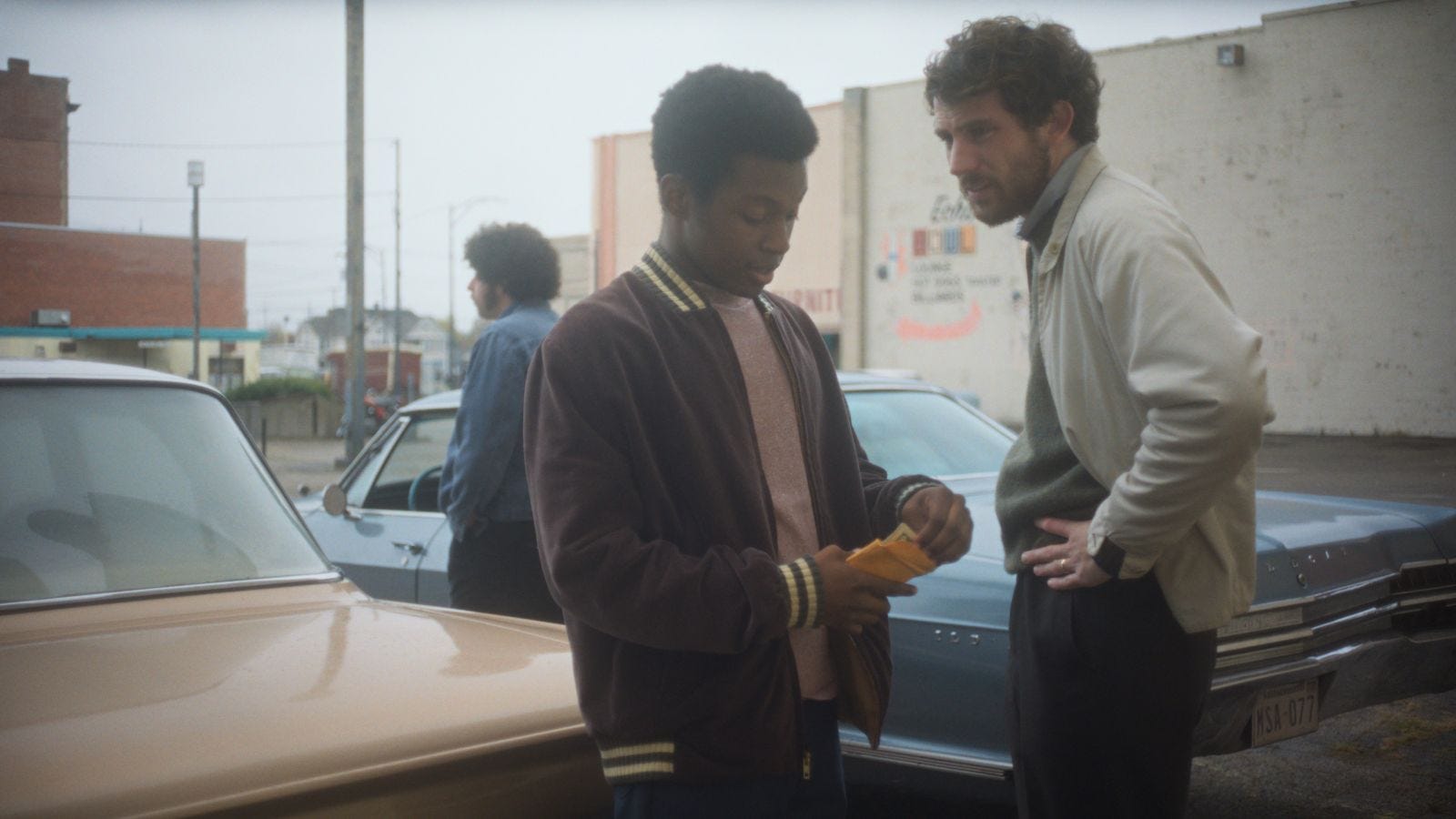
Few scenes this year act as a better litmus test for audience perceptions than the ladder sequence in Kelly Reichardt’s excellent anti-heist film, The Mastermind. In it, the titular “mastermind” J.B. Mooney (played with a spirited lack of ego by Cinema Year Zero-fave Josh O’Connor) carries a box of stolen paintings to a barn, removes them one by one, takes each painting—and the box!—up a ladder into the hayloft, before placing them carefully back into the crate. It lasts around 10 minutes.
For those in tune with Reichardt’s brand of wry, understated Americana, it’s a delightful ellipsis, providing space to ruminate on the details of process à la Bresson, only to further jab at Mooney’s inflated ego and lack of foresight. For those, shall we say, less in tune, it’s a specifically arthouse form of anticlimax, a test of patience that could even be read as “trolling”. That it engages with Reichardt’s recurrent preoccupations concerning the conflict between individualism and community while simultaneously proving so divisive speaks to the film’s quiet, irreverent boldness. BR